On this page
How to identify it
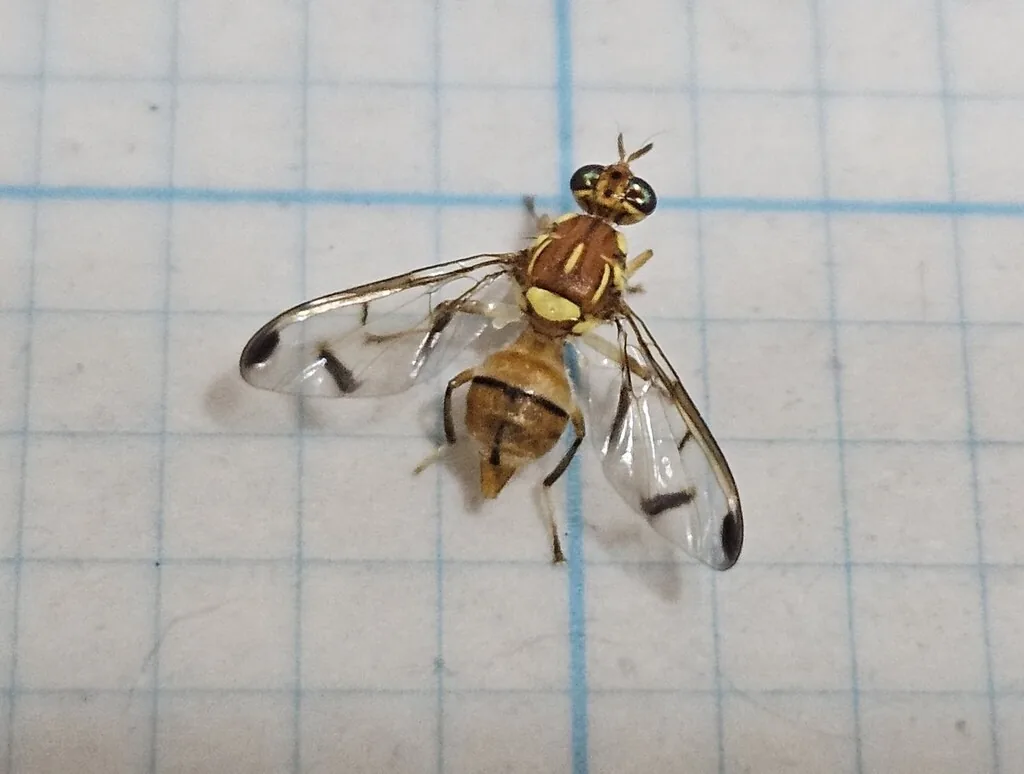
- The adult is about 1/4 to 1/3 inch (6 to 8 mm) long, with a distinctive wing pattern and a long third antennal segment.[1]
- The top of the thorax is reddish yellow with light yellow markings and no black markings, and the head is yellowish with black spots.[1]
- The maggot is white (it can look colored by the food in its gut), with the usual fruit fly maggot shape, and grows to about 7.5 to 12 mm.[1]
- The pupal case is 5 to 6 mm long and ranges from dull red or brownish yellow to dull white, depending on what the larva fed on.[1]
Look-alikes
| Look-alike | How to tell them apart |
|---|---|
| Oriental fruit fly | The oriental fruit fly has prominent dark brown to black markings on the thorax, which the melon fly lacks. The two also answer to different male lures: methyl eugenol draws oriental fruit fly males and cue-lure draws melon fly males.[1][2][5] |
Where it lives
India is considered its native home, and it occurs across most of southeastern Asia and in parts of Africa and the Pacific. It reached Hawaii from Japan about 1895 and is established there. It is not established in the continental United States, though it is periodically intercepted in other states.[1]
Biology and life cycle
A single female may lay as many as 1,000 eggs. Most go into young fruit, but she also lays in succulent stems, cutting a cavity with her sharp ovipositor. For some hosts, only ripe fruit is attacked.[1]
Development from egg to adult takes 12 to 28 days in summer, longer in cool weather. Maggots pupate in the soil, usually under the host plant, down to about 2 inches deep. There can be 8 to 10 generations a year.[1]
Adults may live more than a year. They feed on plant juices, nectar and honeydew from other insects.[1]
Adults shelter (roost) in plants bordering crop fields. In a Hawaii test, castor bean, panax, tiger's claw and guava were among the plants they preferred.[3]
Damage and signs
- More than 125 plants have been recorded as hosts. Preferred hosts include cantaloupe, cowpea, cucumber, gourd, pumpkin, squash, string bean, tomato and watermelon; eggplant, fig, mango, orange, papaya and peach are occasional hosts.[1]
- It attacks flowers, stems and roots as well as fruit. In Hawaii, pumpkin and squash have been heavily attacked before the fruit set, with eggs laid in unopened flowers and maggots developing in taproots, stems and leaf stalks.[1]
Health risk
The sources describe it only as a crop pest and mention no harm to people.[1]
Control
Traps and physical control
Trapping programs use cue-lure, which attracts male melon flies. An eradication campaign in the Solomon Islands combined bait spraying with male annihilation traps.[5][1]
Biological control
Two parasitic wasps, Psyttalia fletcheri (which attacks the maggots) and Fopius arisanus (which attacks the eggs), were introduced into Hawaii against it. In Japan's Ryukyu Islands it was eradicated from some islands by releasing sterile flies.[1]
Pesticides
In Hawaii, protein bait mixed with insecticide is sprayed on the plants around field edges where adults roost. In 2017, some Hawaii populations were found to be highly resistant to a spinosad protein bait; in a University of Hawaii trial, rotating it with abamectin, zeta-cypermethrin and malathion baits on a Maui zucchini farm raised marketable fruit from 51% to 98%.[3][4]
When to call a professional
Finds outside Hawaii are handled by agriculture agencies. When flies turned up in Kern County, California, in August 2010, quarantine and eradication measures were put in place quickly.[1]
Common questions
- Is the melon fly found on the US mainland?
- No. It is established in Hawaii but not in the continental United States, where it is often intercepted at ports and occasional finds, such as in California in 2010, have been met with quarantines and eradication.[1]
- Can melon fly maggots live in squash stems?
- In Hawaii, melon fly maggots can develop in the taproots, stems and leaf stalks of pumpkin and squash, not just in the fruit.[1]
Sources
- University of Florida/IFAS Extension (Featured Creatures), “Melon Fly, Bactrocera cucurbitae (Coquillett), EENY-199 (H. V. Weems Jr., J. B. Heppner and T. R. Fasulo; revised March 2012; archival copy).” journals.flvc.org/edis/article/view/119600 (accessed 2026-11-09)
- University of Florida/IFAS Extension (Featured Creatures), “Oriental Fruit Fly, Bactrocera dorsalis (Hendel), EENY-083 (H. V. Weems, J. B. Heppner, J. L. Nation and T. R. Fasulo; revised March 2012; archival copy).” journals.flvc.org/edis/article/view/119599 (accessed 2026-11-09)
- Journal of Insect Science (via NCBI PubMed), “Assessment of attractiveness of plants as roosting sites for the melon fly, Bactrocera cucurbitae, and oriental fruit fly, Bactrocera dorsalis (Journal of Insect Science, 2007; abstract).” pubmed.ncbi.nlm.nih.gov/20334596/ (accessed 2026-11-09)
- Insects (via NCBI PubMed), “Field tests of three alternative insecticides with protein bait for the development of an insecticide rotation program to control melon flies, Zeugodacus cucurbitae (Insects, 2022; abstract).” pubmed.ncbi.nlm.nih.gov/35886806/ (accessed 2026-11-09)
- Environmental Entomology (via NCBI PubMed), “Field longevity of methyl eugenol and cue-lure plugs and associated insecticidal strips: captures of Bactrocera dorsalis and Zeugodacus cucurbitae in Hawaii (Environmental Entomology, 2024; abstract).” pubmed.ncbi.nlm.nih.gov/38956829/ (accessed 2026-11-09)
- iNaturalist, “Bactrocera cucurbitae taxon page (order and family).” www.inaturalist.org/taxa/448876 (accessed 2026-11-09)