On this page
How to identify it
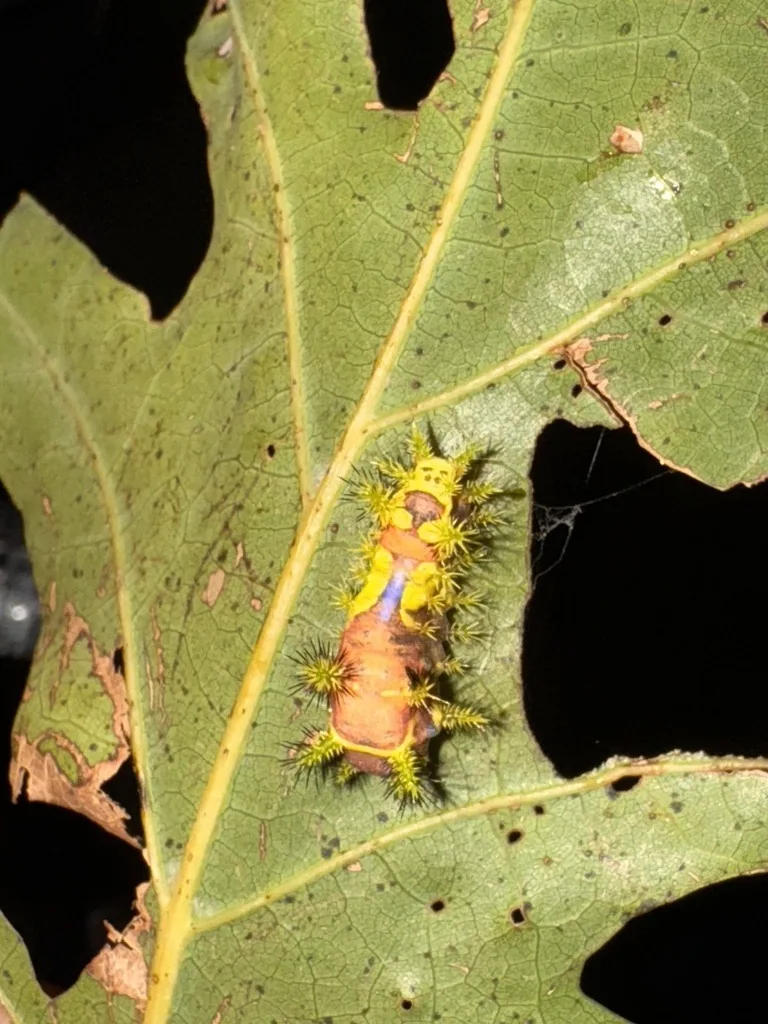
- Caterpillars are green and yellow with blue, green and purple markings and fleshy horns bearing stinging spines; grown larvae are 18 to 24 mm long.[1][2]
- Mature caterpillars spin hard, white and gray-brown cocoons in the forks of small twigs, where they can pass for buds.[1][2]
- Adults are brownish moths about 30 mm long.[2]
Where it lives
Native to East Asia; in the US it is known only from Massachusetts, where cocoons likely arrived in a Boston suburb around 1906, and it is now rarely seen within about 30 miles of Boston.[1][2]
Biology and life cycle
It spends the winter in its cocoon; in Massachusetts adults emerge from late June to early August and lay flat, transparent eggs singly under leaves.[1]
Caterpillars feed from late July into October, first on leaf undersides, later eating whole leaves down to the midrib, through six to eight larval stages.[1][2]
In Asia there are one or two generations a year, depending on climate.[2]
Damage and signs
Health risk
The caterpillars' spines cause a nettle-like irritation on skin, so they should not be handled.[1][2]
Control
Biological control
Parasitoids released near Boston from China and Japan between 1917 and 1930 attacked it, though it is unclear whether they persist.[1]
Pesticides
Chemical treatment is almost certainly unnecessary because populations are too low to cause measurable damage.[1]
When to call a professional
In Massachusetts, photograph any caterpillar you find and report it to the Department of Agricultural Resources (MDAR); MDAR or UMass Extension can help send a sample to USDA APHIS for confirmation.[1]
Common questions
Sources
- UMass Extension Landscape, Nursery and Urban Forestry Program (Landscape Insect & Mite Guide), “Monema (Cnidocampa) flavescens (Oriental Moth, Stinging Nettle Caterpillar).” www.umass.edu/agriculture-food-environment/landscape/publications-resources/insect-mite-guide/monema-cnidocampa-flavescens (accessed 2026-10-16)
- European and Mediterranean Plant Protection Organization (EPPO), “EPPO Alert List: Monema flavescens (Lepidoptera: Limacodidae).” www.eppo.int/ACTIVITIES/plant_quarantine/alert_list_insects/monema_flavescens (accessed 2026-10-16)
- iNaturalist, “Monema flavescens taxon page (order and family).” www.inaturalist.org/taxa/484293 (accessed 2026-10-06)