On this page
How to identify it
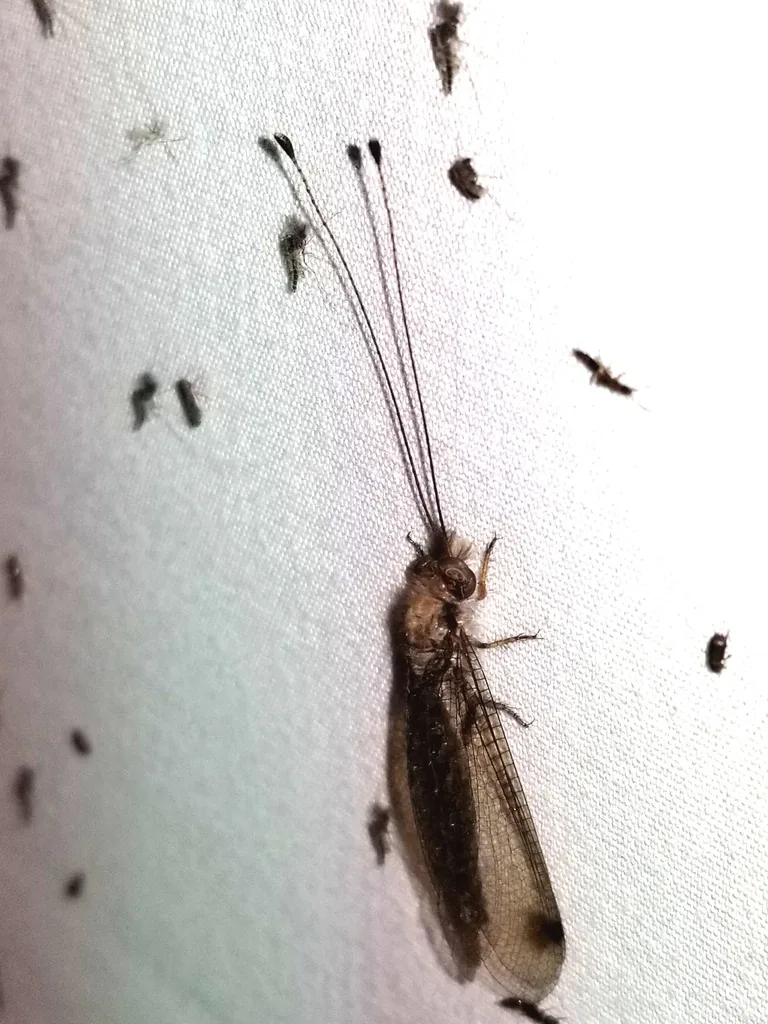
- Adults are shaped and sized like dragonflies, but with long, clubbed antennae and large, bulging eyes, the two features that set owlflies apart.[1][2]
- Missouri Department of Conservation gives a length of up to about 2 inches without appendages, a wingspan of up to about 3 inches, and antennae about 1 inch long.[1]
- At rest on a stem or twig, some hold the abdomen angled away from the perch so that the body looks like a twig.[1]
- In Missouri the two genera can be told apart by the eyes: Ululodes has a groove or crease across each eye, and Ascaloptynx does not. North America has only one Ascaloptynx, A. appendiculata.[1]
- The larvae are flattened, oval and gray, brown or black, with a pair of huge caliperlike jaws usually held wide open; in Ululodes larvae the jaws can open to an angle of 270 degrees or more. A fringe of finger-like side extensions (scoli) runs along the body, and some species glue sand or other debris to their backs for camouflage.[1][5]
Look-alikes
| Look-alike | How to tell them apart |
|---|---|
| Dragonflies | Owlflies resemble dragonflies in shape and size but are unrelated to them. Their long, clubbed antennae and bulging eyes set them apart.[1] |
| Antlions | Adult antlions look like fragile, drab damselflies with antennae about as long as the head and thorax combined, much shorter than an owlfly's. Antlion larvae look a lot like owlfly larvae, but owlfly larvae have a fringe of tiny finlike projections along the sides.[2][1] |
Where it lives
Missouri Department of Conservation counts eight owlfly species in North America north of Mexico and says most of the family lives in the tropics; in Missouri they occur statewide. Larval studies have used owlflies from central Florida and from southeastern Arizona, including the Chiricahua Mountains.[1][5]
Biology and life cycle
Adults are mostly active at dawn and dusk or at night, many come to lights, and they are most active in summer. They catch insects in the air, the way dragonflies do.[1]
Their eyes are built for this. A study of a European day-flying owlfly found eyes sensitive to ultraviolet light and suited to picking out small insect prey as dark spots against clear or cloudy sky.[7]
Females lay eggs in a line on twigs. Nearby they add smaller trophic eggs that never hatch: these may give the hatchlings a first meal and keep them from eating each other, and they ring the stem like a fence.[1]
That fence works. These egg barriers, called repagula, are abortive eggs, and in Arizona experiments egg clusters guarded by them were left alone by every ant species tested, while unguarded eggs were quickly found and carried off. Ants that touched a repagulum pulled back at once.[4]
Young larvae drop from the twig to the ground and live in leaf litter. Like antlion larvae they are ambush predators, sitting still with their jaws open until prey walks by.[1][3]
Larvae pass through three stages before pupating; full-grown larvae measured 13 to 19 mm for Ululodes and 16 to 22 mm for Ascaloptynx, not counting the jaws. They pupate in silk cocoons in the leaf litter.[5][1]
Carrying debris for camouflage is an old habit: owlfly larvae preserved in Cretaceous amber already carried sand grains, plant fragments and other debris.[6]
Health risk
Missouri Department of Conservation describes owlflies as harmless. They feed on other insects.[1]
Control
Prevention
No control is needed. As predators at every life stage, owlflies help control the insects they eat.[1]
Where sources disagree
Family: Missouri Department of Conservation lists owlflies as their own family, Ascalaphidae, while noting antlions and owlflies are sometimes grouped in one family. A 2022 review says neither group's status is settled and either may be nested inside the other; iNaturalist currently treats owlflies as a subfamily of the antlion family Myrmeleontidae.[1][2][3]
Common questions
- Is an owlfly a kind of dragonfly?
- No. Owlflies resemble dragonflies but are unrelated to them; they are lacewing relatives, very close to antlions, and they have long, clubbed antennae and bulging eyes.[1][2][3]
- Are owlflies harmful?
- No. Missouri Department of Conservation calls them harmless, and both adults and larvae are predators of other insects.[1]
- Why is there an owlfly at my porch light?
- Many owlflies are active at dusk, dawn or night and are attracted to lights, especially in summer.[1]
Sources
- Missouri Department of Conservation, “Owlflies (Field Guide).” mdc.mo.gov/discover-nature/field-guide/owlflies (accessed 2026-11-11)
- Missouri Department of Conservation, “Antlion Adults (Field Guide).” mdc.mo.gov/discover-nature/field-guide/antlion-adults (accessed 2026-11-11)
- Insects (MDPI), full text in PubMed Central (PMC9316203), “Haug et al. The Morphological Diversity of Antlion Larvae and Their Closest Relatives over 100 Million Years. Insects 13: 587 (2022), doi:10.3390/insects13070587.” doi.org/10.3390/insects13070587 (accessed 2026-11-11)
- Psyche: A Journal of Entomology (Cambridge Entomological Club), journal archive, “Henry CS. Eggs and repagula of Ululodes and Ascaloptynx (Neuroptera: Ascalaphidae): a comparative study. Psyche 79: 1-22 (1972).” groups.csail.mit.edu/mac/projects/psyche/79/79-001.html (accessed 2026-11-11)
- Psyche: A Journal of Entomology (Cambridge Entomological Club), journal archive, “Henry CS. Some aspects of the external morphology of larval owlflies (Neuroptera: Ascalaphidae), with particular reference to Ululodes and Ascaloptynx. Psyche 83: 1-31 (1976).” groups.csail.mit.edu/mac/projects/psyche/83/83-001.html (accessed 2026-11-11)
- Science Advances, via PubMed, “Debris-carrying camouflage among diverse lineages of Cretaceous insects (Wang et al. 2016).” pubmed.ncbi.nlm.nih.gov/27386568/ (accessed 2026-11-11)
- Journal of Experimental Biology, via PubMed, “A cute and highly contrast-sensitive superposition eye: the diurnal owlfly Libelloides macaronius (Belušič et al. 2013).” pubmed.ncbi.nlm.nih.gov/23431000/ (accessed 2026-11-11)
- iNaturalist, “Ascalaphinae taxon page (order and family).” www.inaturalist.org/taxa/153097 (accessed 2026-11-11)