On this page
How to identify it
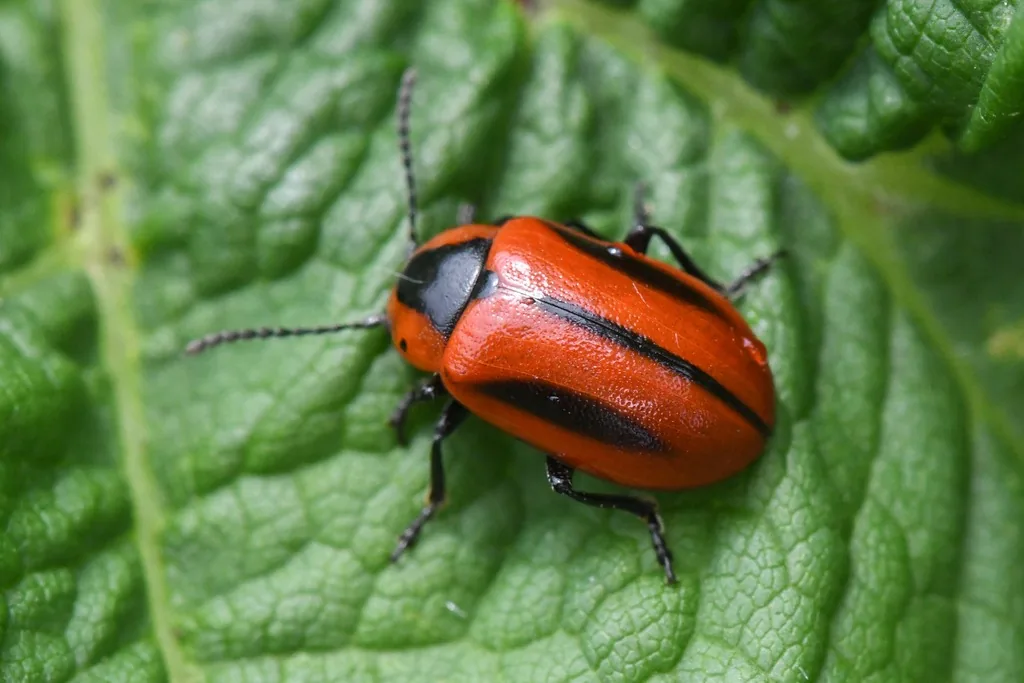
- Adults are bright red and about 7 to 10 mm long, with three distinct black stripes running lengthwise down the back and black markings on and just behind the head.[2][1]
- Larvae are grub-like, smoky black on top and brownish underneath, with rough, segmented skin covered in short hairs. They grow to about 3/8 to 1/2 inch.[1][2]
- Pupae are bright orange, with the legs and other appendages free and visible, and sit in earthen cells in the top inch of soil.[2][1]
- Eggs are reddish-brown and oblong, laid singly or in clusters in shallow soil crevices or under clods, leaves and other debris.[2]
Where it lives
Native to North America. It is an occasional pest in the northern Great Plains and relatively abundant in the Aspen Parkland of the Canadian Prairies and the Peace River District. It is also present in Washington, Idaho, Montana, Wyoming, Colorado, North Dakota, Minnesota and Wisconsin, where it rarely damages crops, and it is more common in areas with sandy soils.[2][1]
Biology and life cycle
There is one generation a year, and the insect spends the winter as eggs in the soil.[1][2]
Eggs are laid from early August to late October near the plants the adults are feeding on. They mature within 2 to 3 weeks but stay dormant until late March to early May, hatching after the snow melts and before crops are seeded.[2][1]
The larvae feed by day on volunteer canola, rapeseed and mustard and on mustard-family weeds such as flixweed and wild mustard, and when disturbed they drop to the soil, where their color blends in. They molt three times and finish growing in three to four weeks, usually by the end of May.[2][1]
Mature larvae pupate in earthen cells in the soil. Pupae are present from mid-May to mid-June, and adults emerge from early to late June.[2][1]
New adults feed for two to three weeks, usually in the same field where they fed as larvae, and walk to the nearest food if it runs out. Near the end of June, in response to high temperatures, they go back into the soil for about a month, then reappear in late July and spread quickly into new fields.[2][1]
Feeding, mating and egg laying continue until late October, and each female produces about 300 to 400 eggs.[2][1]
Damage and signs
- Larvae and adults feed on the seed leaves, true leaves, leaf stalks and stems of seedlings. Damage ranges from small bites out of the leaves to complete defoliation and death, and small seedlings are the most susceptible.[2][1]
- In fields, injury usually starts at the margins as beetles walk in from neighboring mustard-family plants that have been eaten or controlled, often as a moving front only a few yards wide. When adults are numerous, they work inward from the edges.[2][1]
- Infestations start in stubble of canola, rapeseed or mustard, or in fields thick with mustard-family weeds or volunteers that were not cultivated or sprayed in the fall or early spring.[2][1]
- The larvae seldom threaten canola, mustard or rapeseed crops because they usually finish developing before the crop comes up. The adults that return in late summer feed on flowers, pods and stems, but their feeding is usually not severe.[2][1]
- Manitoba notes that direct seeding, zero-till and chemical summerfallow practices may contribute to this insect becoming a more important crop pest.[2]
Health risk
A plant pest. The University of Minnesota and Manitoba Agriculture describe damage to mustard-family plants only and mention no risk to people or pets.[1][2]
Control
Prevention
Control volunteer canola, rapeseed and mustard and mustard-family weeds, since infestations build on them and then move into neighboring plantings. Avoid underseeding canola, rapeseed or mustard with forages.[1][2]
Traps and physical control
Cultivation is very effective against the soil stages. Cultivating after harvest buries the eggs so newly hatched larvae cannot dig out, and Manitoba reports fall cultivation can kill 75 to 100 percent of the larvae hatching the next spring.[2][1]
Cultivation and herbicides also starve the larvae by destroying their host plants, since larvae cannot travel far for food. Cultivating from mid-May to mid-June cuts populations further by exposing pupae to injury, predators and drying out.[2][1]
Pesticides
Insecticide may be needed when adults invade newly seeded fields in June. Check beetle numbers and damage first; because the beetles walk in from the edges, treatment can usually be confined to the field margins. Late-June invasions seldom cause economic damage because plants are larger and the beetles will soon go into the soil to rest. Check current local recommendations, such as the Midwest Vegetable Production Guide, before spraying.[2][1]
Common questions
- What are the red beetles with black stripes eating my radishes and turnips?
- Bright red beetles with three black stripes down the back, feeding on turnip, radish, mustard or other mustard-family plants, fit the red turnip beetle.[1][2]
- Why do the beetles disappear in July and then come back?
- Near the end of June, in response to high temperatures, adults go back into the soil for about a month, then reappear in late July. Their feeding after they return is usually not severe.[2][1]
- How can I keep red turnip beetles away next year?
- Control mustard-family weeds and volunteer plants, and cultivate after harvest or in fall to bury the eggs. Manitoba reports that fall cultivation can kill 75 to 100 percent of the next spring's newly hatched larvae.[1][2]
Sources
- University of Minnesota Extension (VegEdge), “Red Turnip Beetle, VegEdge vegetable IPM resource.” vegedge.umn.edu/node/121 (accessed 2026-11-08)
- Manitoba Agriculture, Government of Manitoba, “Red Turnip Beetle.” www.gov.mb.ca/agriculture/crops/insects/red-turnip-beetle.html (accessed 2026-11-08)
- iNaturalist, “Entomoscelis americana taxon page (order and family).” www.inaturalist.org/taxa/451164 (accessed 2026-11-08)