On this page
How to identify it
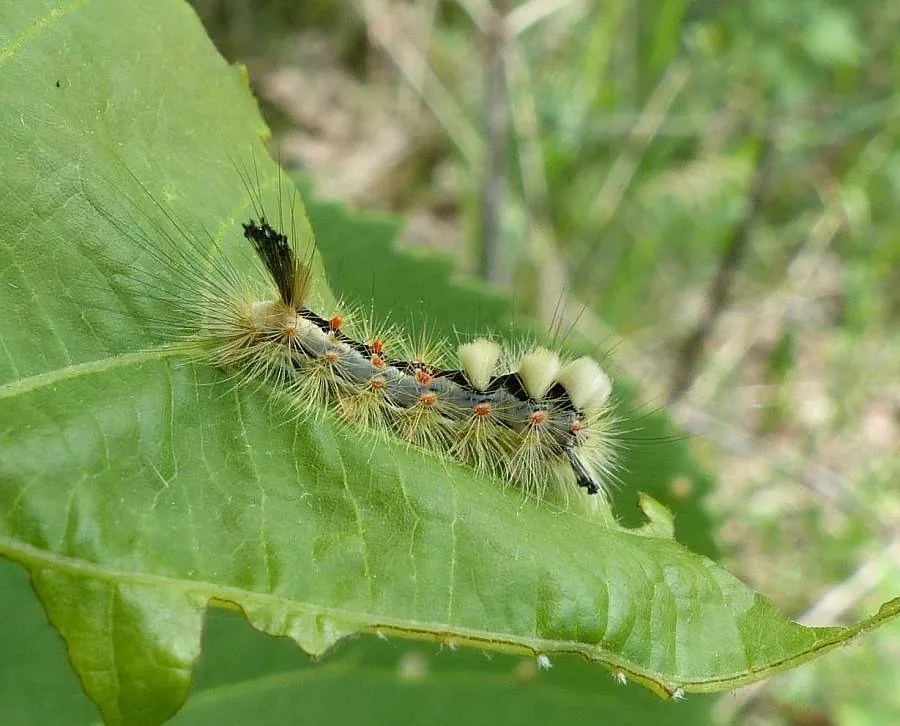
- The full-grown caterpillar is about 30 mm (1.2 inches) long, with a black head and body. It has four dense tufts on the middle of its back, described as white to yellowish or orangish to straw-colored, and long hairs radiating from orange bumps on the rest of the body.[1][2]
- Two long black pencil-like tufts stick forward over the head, and a third long black tuft points back from the rear end.[1][2]
- The USDA Forest Service caterpillar guide separates it from the white-marked tussock moth by its grayer to browner color and the red-orange shield behind the head, which has a dark triangle in the middle.[3]
- The female moth looks wingless; her wings are reduced to stubs. The male flies well and has rusty red-orange wings with a white spot at the middle of the back part of each forewing, a wingspan of about 30 mm, and large feathery antennae.[1]
- Eggs are laid in a loose cluster. Unlike many other tussock moths, the eggs are not covered with hairs or secretions.[1]
Look-alikes
| Look-alike | How to tell them apart |
|---|---|
| White-marked tussock moth | A native relative with a hairy caterpillar and a flightless female. Its caterpillar is bright black, yellow and red, usually with a red head and red glands on the back, and whitish tufts. The rusty tussock moth caterpillar is grayer to browner.[1][3] |
| Douglas-fir tussock moth | Feeds mainly on Douglas-fir and true firs. Its full-grown caterpillar has lighter tufts on the back, red spots on top and an orange stripe along each side. Male rusty tussock moths come to the same pheromone lure used to trap this species.[2][1] |
| Western tussock moth | A relative whose gray caterpillar has bright blue, red and yellow spots along with its white tufts.[2] |
Where it lives
Native to Europe and now established throughout the northern hemisphere. In North America it is established across Canada and south to the mid-Atlantic states and northern California, in coastal, mountain and mixed temperate forests, and it is reported more often in moist coastal climates than in drier inland areas.[1]
Biology and life cycle
It feeds on more than 50 conifer and hardwood species, including alder, birch, willow, oak, poplar, Sitka spruce and Douglas-fir, as well as understory plants such as blueberry. Its wide diet lets it live in heathlands and on ornamental plants in towns.[1]
It spends the winter as eggs. Caterpillars hatch in late spring and often spread by ballooning on silk threads carried by the wind, then feed through the summer.[1][2]
They pupate in a loose silk cocoon in late July to early August, and adults come out within two weeks. The flightless female releases a scent (pheromone) that draws males, and after mating she lays hundreds of eggs.[1]
There is one generation a year in Canada; at least a partial second generation has been reported in other areas.[1]
Damage and signs
- Feeding shows up in early summer as holes and ragged leaf edges on broadleaf plants and clipped needles on conifers, mostly at the top of the tree and the branch tips. At high numbers the caterpillars may also chew the soft bark of twigs.[1]
- It rarely causes significant damage. Now and then it builds up enough to hurt fruit trees, bushes, or nursery and landscape trees, but such outbreaks are local and short-lived, and damaged plants usually recover.[1]
Health risk
Some people have allergic reactions to the caterpillar's irritating hairs, a condition called tussockosis. Tussock moth hairs come off easily when touched and connect to poison sacs under the caterpillar's skin.[1][2]
Control
Prevention
Because damage is normally light, it usually needs no action. Pheromone traps for males, followed by searches for egg clusters, can show where populations are building.[1]
Traps and physical control
On shrubs and small trees, removing egg masses, newly hatched caterpillars and cocoons gives some control. Wear chemical-resistant gloves and clothing that covers the skin, and avoid breathing in caterpillar parts.[2]
Biological control
For tussock moths in general, predatory beetles, assassin bugs, and parasitic tachinid flies and wasps help keep numbers low, and a virus disease can quickly reduce caterpillar numbers, though often not until trees have been heavily fed on.[2]
Pesticides
UC IPM says tussock moths generally do not warrant insecticides unless plants are young or otherwise unhealthy. If treatment is needed, Bacillus thuringiensis (Bt) works best on young caterpillars. Spinosad is also effective but is toxic to bees for several hours after it dries, so do not spray it on flowering plants.[2]
Common questions
- Is the rusty tussock moth caterpillar dangerous to touch?
- Its hairs can cause allergic reactions in some people. Avoid handling the caterpillars, and wear gloves and covering clothing if you remove them.[1][2]
- Why do I only see males flying?
- The female's wings are reduced to stubs, so she cannot fly. She draws males to her with a scent (pheromone).[1]
- Will rusty tussock moths kill my trees?
- Rarely. Outbreaks are usually local and short-lived, and damaged plants usually recover.[1]
Sources
- Natural Resources Canada, Canadian Forest Service, “Rusty tussock moth (V. G. Nealis, revision 2025), Trees, insects and diseases of Canada's forests.” tidcf.nrcan.gc.ca/en/insects/factsheet/1000089 (accessed 2026-11-09)
- University of California Statewide IPM Program, “Tussock Moths (Home and Landscape).” ipm.ucanr.edu/home-and-landscape/tussock-moths/ (accessed 2026-11-09)
- USDA Forest Service, Forest Health Technology Enterprise Team, “Caterpillars of Eastern Forests, FHTET-96-34 (D. L. Wagner et al., 1997).” archive.org/details/caterpillarsofea001997 (accessed 2026-11-09)
- iNaturalist, “Orgyia antiqua taxon page (order and family).” www.inaturalist.org/taxa/61910 (accessed 2026-11-09)