On this page
How to identify it
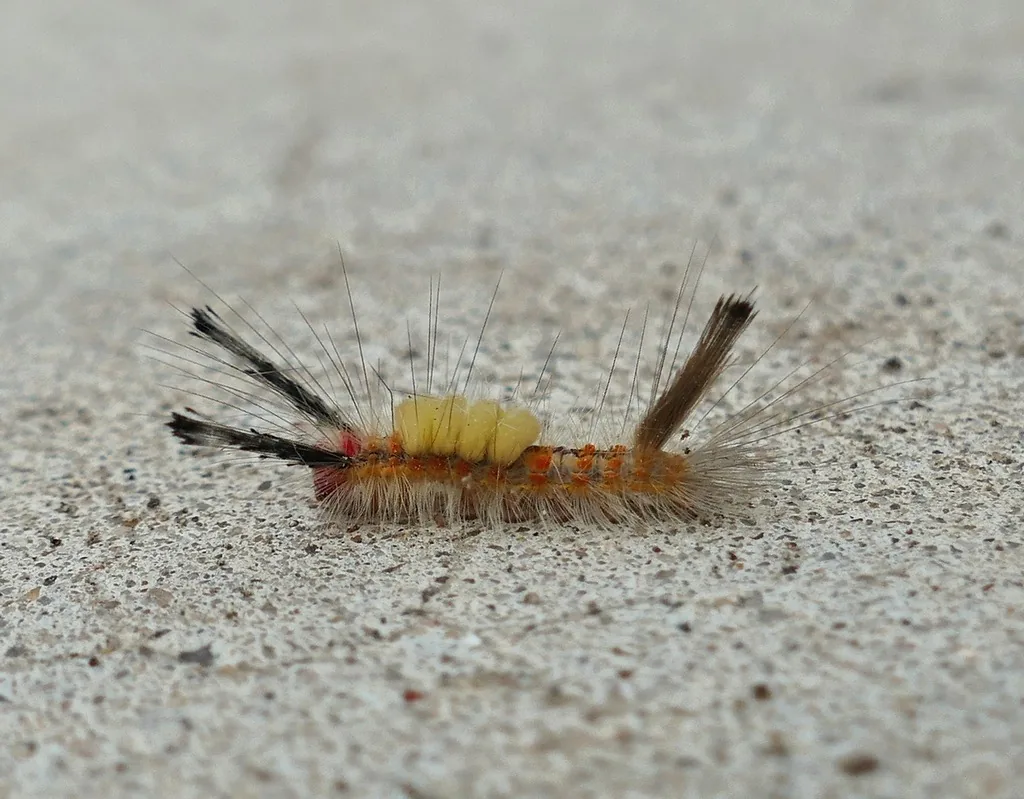
- Caterpillars are 1 to 1 1/2 inches long with a bright red head. Four dense tufts of hair (the tussocks) sit on the back of the first four abdominal segments, a pencil of black hairs rises from the eighth, and two pencils of black hairs project forward from just behind the head.[1]
- Two small glands on the middle of the back near the rear (on abdominal segments six and seven) are orange, and bright orange spots dot the back and sides. In Florida the sides come in a dark gray form and a light gray to pale yellow form.[1]
- Males are small, rather dull moths with prominent comb-like antennae, and they rest with their front legs stretched forward; Orgyia moths have a wingspread of about 0.8 to 1.4 inches. Females have only short wings and cannot fly.[1]
- Cocoons are made of silk mixed with the caterpillar's hairs. Look for them in bark furrows, on the undersides of limbs, in tree cavities, under loose bark, often under the soffits of buildings, and in dense masses among Tillandsia air plants such as ballmoss.[1]
Look-alikes
| Look-alike | How to tell them apart |
|---|---|
| Whitemarked tussock moth | Its caterpillar has bright red rather than orange glands near the rear of the back, yellow rather than orange spots, and a white or yellow line along each side of the dark midline. Fresh males have a purplish tint and a whitish spot near the hind corner of the forewing, which fir tussock moth males lack.[1] |
| Definite tussock moth (Orgyia definita) | Its caterpillar has a tan or yellow head instead of a red one, pale yellow glands near the rear of the back, and a lighter body overall.[1] |
Where it lives
It lives on the Coastal Plain from Long Island to Florida and along the Gulf States west to Texas, and it is uncommon in the northern part of that range. In Florida it is the most common of the three Orgyia tussock moths.[1]
Biology and life cycle
There is one generation a year. In Florida the overwintering eggs start to hatch in late February, and the young caterpillars eat what is left of the egg mass before drifting off on silk threads, a habit called ballooning.[1]
Because the females cannot fly, ballooning by the young caterpillars is the main way the species spreads.[1]
Young caterpillars chew holes in the leaves, and older ones feed from the leaf edges. The only documented hosts are oaks and bald cypress.[1]
In early April in Florida, grown caterpillars wander off to find places to spin their cocoons, often leaving the host tree for buildings, fences and other structures.[1]
Moths emerge from mid-April to early May. The flightless female stays on her cocoon and releases a sex pheromone to attract males, then lays her eggs on the cocoon and covers them with a secretion and hairs rubbed from her body. The eggs spend the winter there.[1]
Researchers identified two mirror-image forms of a long-chain alcohol as the main components of the female sex pheromone. In field trapping, the two together, but not either one alone, drew significant numbers of males.[3]
Tussock moth caterpillars have many enemies: birds, large ground beetles and Polistes paper wasps eat them, and a nuclear polyhedrosis virus kills caterpillars that are then found hanging limp by their prolegs. Parasitoids of this species haven't been well studied, but it is thought to have many.[1]
Damage and signs
- In Florida, feeding by Orgyia caterpillars usually doesn't harm large trees, but now and then they are numerous enough to strip large trees completely, and large numbers blown onto small landscape trees can severely defoliate them. UF/IFAS shows a large live oak defoliated by fir tussock moth caterpillars.[1]
- The bigger nuisance for most people is the spring wandering, when caterpillars leave the trees to spin cocoons on houses, fences and other structures.[1]
Health risk
The hairs of tussock moth caterpillars cause itchy dermatitis, and cocoons cause the same symptoms. People are exposed when caterpillars drop from trees or wander, and homeowners get rashes handling cocoons while removing them from soffits; cocoon hairs stay irritating for a year or longer. Welts usually appear within minutes and fade by the next day, though itching and redness often last another day or two, and some people are more sensitive than others. For tussock moth rashes in children in Hillsborough County, Florida (traced to the related whitemarked tussock moth), CDC's report lists stripping the hairs off with adhesive tape, washing with soap and water, ice packs and a low-potency steroid cream, and says to contact a health-care provider if the eyes are involved, the person has hay fever, asthma or allergies, or an allergic reaction develops.[1][2]
Control
Prevention
Keep people, especially children, from handling the caterpillars and cocoons. After the 2011 rash outbreaks at Florida child care centers and a school, which were linked to the related whitemarked tussock moth, the health department also recommended power-washing playground equipment to remove caterpillars, cocoons and their hairs.[2]
Traps and physical control
Homeowners get rashes from handling cocoons while clearing them from soffits, and the hairs in cocoons stay irritating for up to a year or longer, so avoid skin contact with cocoons as well as caterpillars.[1][2]
Pesticides
Control is difficult, because by the time the caterpillars are migrating from the trees it is too late. If treatment is needed, the insecticides or Bacillus thuringiensis products recommended for other caterpillars should work; ask your county Extension office for current recommendations.[1]
Common questions
- Why is it called the fir tussock moth if it lives on oaks?
- The name doesn't fit well: the only documented hosts are oaks and bald cypress.[1]
- Why are fuzzy caterpillars crawling on my house in spring?
- In early April in Florida, grown caterpillars leave the trees to look for sheltered places to spin cocoons, such as under soffits and on fences, and the females later lay their eggs right on those cocoons.[1]
- Can tussock moth cocoons give you a rash?
- Yes. The cocoons are woven with the caterpillar's hairs and cause the same itchy rash as the caterpillars, and those hairs can stay irritating for a year or longer.[1]
Sources
- University of Florida/IFAS Extension (Featured Creatures), “Fir Tussock Moth, Orgyia detrita, EENY588/IN1032 (D. W. Hall and L. Buss, February 2014; EDIS historical fact sheet).” journals.flvc.org/edis/article/view/138247 (accessed 2026-11-08)
- Centers for Disease Control and Prevention (MMWR), “Caterpillar-Associated Rashes in Children - Hillsborough County, Florida, 2011 (MMWR 61(12): 209-212, March 30, 2012).” www.cdc.gov/mmwr/preview/mmwrhtml/mm6112a3.htm (accessed 2026-11-08)
- Journal of Chemical Ecology (via NCBI PubMed), “Enantiomers of (Z,Z)-6,9-heneicosadien-11-ol: sex pheromone components of Orgyia detrita (R. Gries et al.; Journal of Chemical Ecology 29(10): 2201-2212, 2003; abstract).” pubmed.ncbi.nlm.nih.gov/14682506/ (accessed 2026-11-08)
- iNaturalist, “Orgyia detrita taxon page (order and family).” www.inaturalist.org/taxa/49016 (accessed 2026-11-08)