On this page
How to identify it
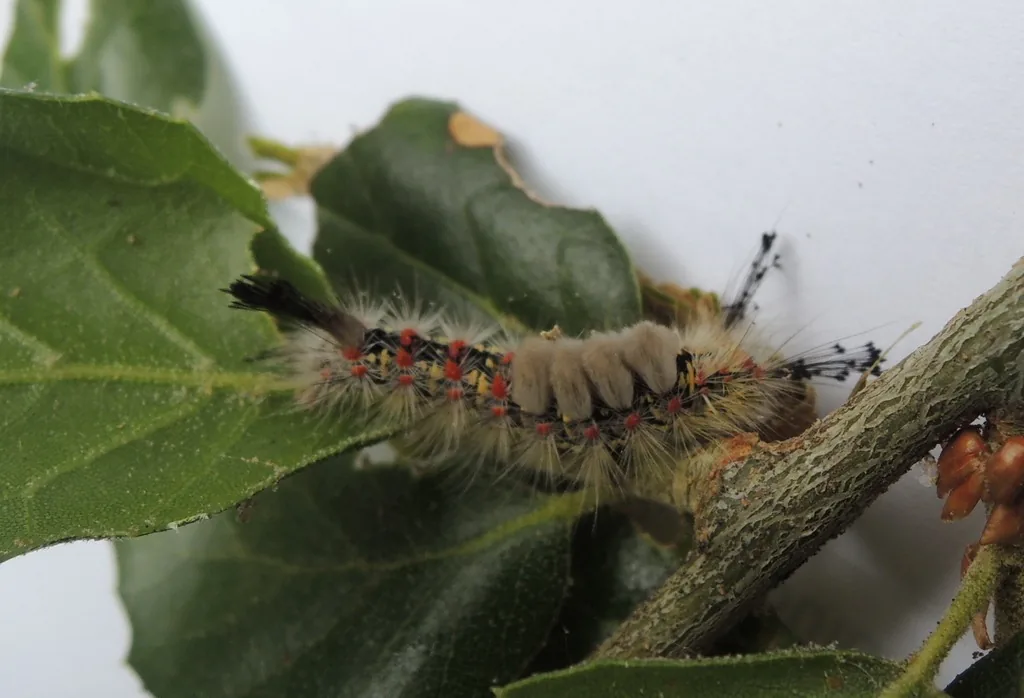
- The mature caterpillar is gray with many bright blue, red and yellow spots, each with gray to white hairs radiating from it. It has four dense white tufts of hair on its back, two black tufts at the head end, and a black and a white tuft at the rear.[1][2]
- Young caterpillars are black and hairy, with long bristles.[1][3]
- Adult females are large, mostly gray and wingless; males are winged, hairy moths. Tussock moth males have a wingspan of about 1 1/2 inches.[4][1]
- The eggs are laid in a single felt-like mass of 125 to 300 on an empty cocoon. Tussock moth egg masses are covered with the female's brownish hairs and look much like the hair-covered cocoon itself.[3][2][1]
Look-alikes
| Look-alike | How to tell them apart |
|---|---|
| Rusty tussock moth (Orgyia antiqua) | Its caterpillar has a black body with gray to tan hairs, three long black tufts (two at the front, one at the rear) and four orangish to straw-colored tufts along the back, instead of the western tussock moth's gray body with blue, red and yellow spots and white tufts.[1] |
| Douglas-fir tussock moth | Feeds mainly on Douglas-fir and true firs rather than on fruit trees, oaks and shrubs.[1] |
Where it lives
UC IPM calls it common throughout California, especially in unsprayed orchards, and an occasional pest in coastal apricot orchards. Several of the studies cited here followed populations on bush lupine on the coast north of San Francisco, including the Bodega Marine Reserve in Sonoma County.[3][2][5][6][10]
Biology and life cycle
Hosts include fruit and nut trees such as apple, apricot and pistachio, along with hawthorn, manzanita, oak, pyracantha, toyon, walnut and willow. On the coast it also feeds on bush lupine.[1][2][3][4][5]
It overwinters as eggs. The caterpillars hatch in March or April as spring growth expands, mature by about May, and pupate on bark in a hairy brown or tan cocoon. The wingless females mate in early summer and lay their eggs on the old cocoon.[1][2][3][4]
UC IPM's orchard guidelines describe one generation a year, but in southern California there may be two, with second-generation caterpillars from about late August to October.[2][3][1]
Because the females cannot fly, the moth spreads mainly as newly hatched caterpillars that float on the wind on silk strands. In a release experiment in uninfested lupine stands, the median distance moved over a whole generation was only 2 meters, and UC IPM notes that population increases tend to stay localized.[1][8][5][2]
Natural enemies matter. The tiny wasp Telenomus californicus kills many eggs; a chalcid wasp parasitizes pupae; the ant Formica lasioides eats pupae; and parasitoids spilling out from an outbreak held down nearby experimental populations, which helps explain why outbreaks stay patchy.[1][8][6][7]
Outbreaks also end through disease and food loss. A virus can quickly cut populations, and dead caterpillars hang limply from twigs; a fungus, Entomophaga aulicae, has swept through dense populations on bush lupine; and one outbreak collapsed after two years of explosive growth when its lupines died off.[1][10][9]
Damage and signs
- Caterpillars chew leaves, giving plants a clipped or ragged look, and high local numbers can completely defoliate trees or destroy all the spring growth. Healthy broadleaf plants tolerate the loss of some leaves.[1][3]
- They also take shallow bites out of young fruit. The wounds scab over, russet or discolor, leaving shallow, scabby, depressed areas at harvest. Infestations tend to be spotty within an orchard.[1][2][3]
Health risk
The caterpillars' hairs detach easily and can irritate skin; they are hollow and connect to poison sacs under the skin, and orchard workers who touch the larvae may get rashes. Wind-borne young caterpillars can also be a nuisance when abundant.[1][4]
Control
Traps and physical control
On shrubs and small trees, remove egg masses on old cocoons, newly hatched caterpillars and cocoons; in winter and early spring look for egg masses on twigs, tree trunks and props. Prune out small, localized infestations and destroy them. Wear chemical-resistant gloves and clothing that covers your skin, and avoid breathing in caterpillar parts.[1][2][3]
Biological control
Natural enemies, including predatory beetles, assassin bugs, tachinid flies, parasitic wasps such as the egg parasite Telenomus californicus, and diseases, usually keep western tussock moth to occasional outbreaks.[1][2]
Pesticides
UC IPM says tussock moths generally do not warrant an insecticide unless plants are otherwise unhealthy or young. Bacillus thuringiensis (Bt) works best while most caterpillars are small, with a second application 7 to 10 days later because it breaks down quickly; older caterpillars are harder to control. Spinosad also works but is toxic to bees for several hours after it dries, so don't apply it to plants in flower.[1][2]
Common questions
- Can western tussock moth caterpillars hurt me?
- Their hairs can. They break off easily and can irritate skin, and orchard workers who handle the caterpillars may get rashes. Wear gloves and clothing that covers your skin if you remove them.[1][4]
- Why is one tree or bush covered in tussock caterpillars while the next one is fine?
- The females are wingless, so the moth spreads poorly, mostly as tiny caterpillars carried on the wind. Outbreaks therefore stay local, and parasitoids moving out from an outbreak can keep nearby populations down.[2][8][5][7]
- Do I need to spray for western tussock moth?
- Usually not. UC IPM says natural enemies usually keep it under control and that tussock moths generally don't warrant an insecticide unless plants are unhealthy or young. If you do treat, Bt works best on young caterpillars.[2][1]
Sources
- University of California Statewide IPM Program, “Tussock Moths (Home and Landscape).” ipm.ucanr.edu/home-and-landscape/tussock-moths/ (accessed 2026-11-09)
- University of California Statewide IPM Program, “Apricot Pest Management Guidelines: Western Tussock Moth.” ipm.ucanr.edu/agriculture/apricot/western-tussock-moth/ (accessed 2026-11-09)
- University of California Statewide IPM Program, “Apple Pest Management Guidelines: Western Tussock Moth.” ipm.ucanr.edu/agriculture/apple/western-tussock-moth/ (accessed 2026-11-09)
- University of California Statewide IPM Program, “Pistachio Pest Management Guidelines: Western Tussock Moth.” ipm.ucanr.edu/agriculture/pistachio/western-tussock-moth/ (accessed 2026-11-09)
- Oecologia (via NCBI PubMed), “Resources and dispersal as factors limiting a population of the tussock moth (Orgyia vetusta), a flightless defoliator (S. Harrison; Oecologia 99(1-2): 27-34, 1994; abstract).” pubmed.ncbi.nlm.nih.gov/28313945/ (accessed 2026-11-09)
- Oecologia (via NCBI PubMed), “Evidence that predator satiation may restrict the spatial spread of a tussock moth (Orgyia vetusta) outbreak (S. Harrison and C. Wilcox; Oecologia 101(3): 309-316, 1995; abstract).” pubmed.ncbi.nlm.nih.gov/28307051/ (accessed 2026-11-09)
- Science (via NCBI PubMed), “Spatial pattern formation in an insect host-parasitoid system (J. L. Maron and S. Harrison; Science 278(5343): 1619-1621, 1997; abstract).” pubmed.ncbi.nlm.nih.gov/9374460/ (accessed 2026-11-09)
- Ecology (via NCBI PubMed), “Local population size in a flightless insect: importance of patch structure-dependent mortality (H. J. S. Yoo; Ecology 87(3): 634-647, 2006; abstract).” pubmed.ncbi.nlm.nih.gov/16602293/ (accessed 2026-11-09)
- Oecologia (via NCBI PubMed), “Origin of an insect outbreak: escape in space or time from natural enemies? (J. L. Maron, S. Harrison and M. Greaves; Oecologia 126(4): 595-602, 2001; abstract).” pubmed.ncbi.nlm.nih.gov/28547245/ (accessed 2026-11-09)
- Journal of Invertebrate Pathology (via NCBI PubMed), “A disjunct Californian strain of Entomophaga aulicae infecting Orgyia vetusta (A. E. Hajek, S. R. Walsh, D. R. Strong and J. C. Silver; Journal of Invertebrate Pathology 68(3): 260-268, 1996; abstract).” pubmed.ncbi.nlm.nih.gov/8931365/ (accessed 2026-11-09)
- iNaturalist, “Orgyia vetusta taxon page (order and family).” www.inaturalist.org/taxa/61908 (accessed 2026-11-09)