On this page
How to identify it
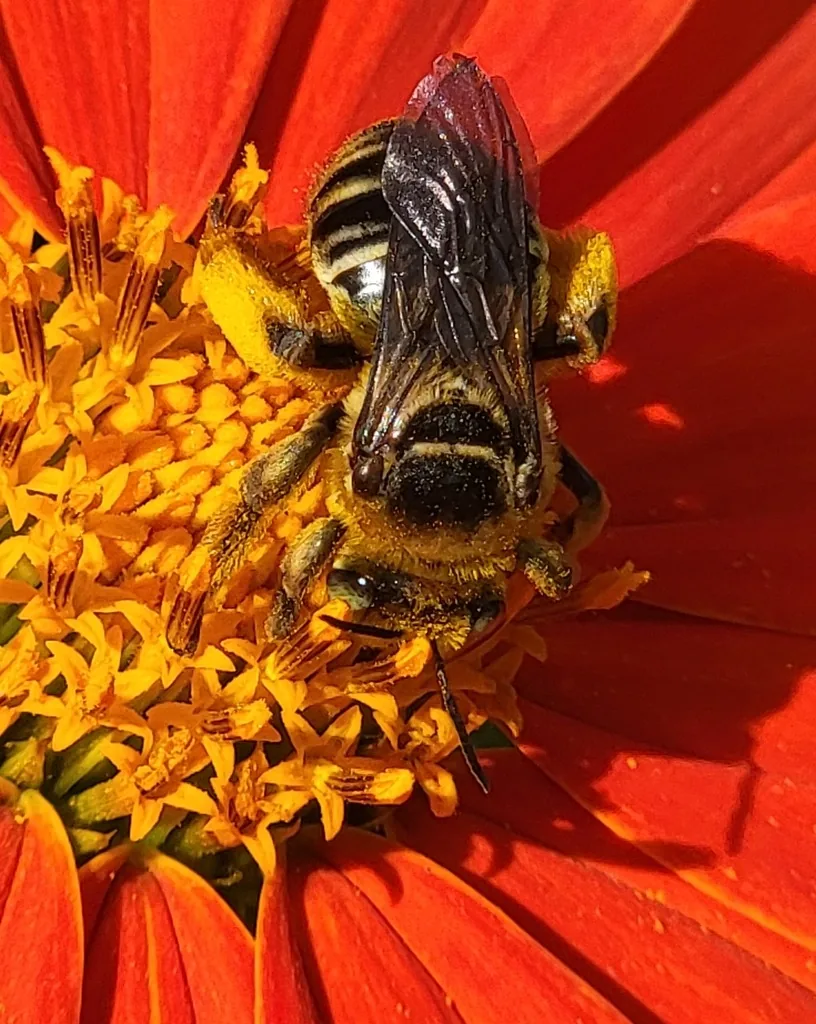
- Females are 14 to 18 mm long and 5 to 6.5 mm wide, with pale brown wings with darker veins, soft yellowish hair on the face, thorax and legs, and a dense band of pale hairs at the end of the abdomen. The top of the thorax is dull and textured, and the eyes run nearly straight along the sides of the head.[1]
- Males are slightly smaller (14 to 17 mm) and easy to recognize by bright yellow markings on the face; their eyes angle slightly inward at the bottom, their body sides are more roughly textured, and their pale yellowish hair turns darker brownish gray on parts of the back.[1]
- In both sexes the hair wears with age, which can make older individuals harder to identify.[1]
- Look for it on sunflowers, blanketflowers, sneezeweeds, coneflowers, rosinweeds, asters and ironweeds, and for nest entrances about 8 to 9 mm across clustered in sandy ground.[1]
Look-alikes
| Look-alike | How to tell them apart |
|---|---|
| Common long-horned bee (Melissodes bimaculatus) | Another long-horned bee. The sandhills longhorn bee is a large yellowish-haired bee of southeastern sandy habitats with a strong preference for aster-family flowers; males have bright yellow faces.[1] |
| Triepeolus cuckoo bees | Triepeolus concavus lurks around sandhills longhorn bee nests, walking around the entrances, peeking in and slipping inside to lay its eggs on the stored pollen. It is a kleptoparasite, not the nest owner.[2][1] |
| Mining bees (Andrena) | Also ground-nesting solitary bees, but the sandhills longhorn bee is a large, thick-haired Epimelissodes that specializes on composites and nests in the sandy soils of the Southeast.[1] |
Where it lives
Throughout the southeastern United States along the Gulf and Atlantic coastal plains, commonly observed in eastern Texas, Arkansas, Louisiana, Mississippi, Alabama, Florida, Georgia, South Carolina and North Carolina, in grasslands and other wildflower-rich habitats with sandy soils.[1][2]
Biology and life cycle
A ground-nesting solitary bee that does not form colonies but nests in aggregations: a 2023 site at the University of Florida's North Florida Research and Education Center in Quincy had at least 20 active nests in a single eight-row cotton plot, within about 27 square meters, with entrance holes 7.6 to 9.4 mm across. Whether it nests communally or strictly alone could not be determined.[2][1]
Females dig into sandy or loose soil to build nests with several brood cells, laying one egg per cell on a provision of nectar and pollen; the full life cycle (egg, larva, pupa, adult) has not been described in detail.[1]
Males patrol the nesting area, pounce on females to mate, scuffle with rival males and sometimes follow a female into her nest, only to be ejected.[1]
Unlike its mostly generalist relatives, this bee appears to specialize on the aster family: documented floral hosts include sunflowers (Helianthus annuus and native species), Coreopsis, Gaillardia, Helenium, Palafoxia, Ratibida, Rudbeckia hirta, Silphium, Symphyotrichum asters, Vernonia ironweeds, Balduina, Bidens alba, Carphephorus and Chrysopsis.[1]
The cuckoo bee Triepeolus concavus, long known from nests of the related Epimelissodes obliqua, was recorded entering sandhills longhorn bee nests in 2023, a new host association.[2][1]
Damage and signs
- None. This is a pollinator: wild bees including Epimelissodes provide pollination in southeastern farm landscapes, and pollination by Epimelissodes and other wild bees has been shown to raise sunflower yields by up to 45 percent.[1]
Health risk
Neither source mentions stinging or any risk to people or pets; the bee is described as a solitary pollinator of sunflowers and related plants.[1][2]
Control
Prevention
No control is called for. UF/IFAS presents the sandhills longhorn bee as a beneficial native pollinator whose nesting biology is only now being described, and gives no management advice; leave nesting aggregations in sandy ground alone and keep aster-family flowers such as sunflowers, blanketflower and coneflowers for it to forage on.[1][2]
Common questions
- Dozens of big yellowish bees are digging holes in a sandy patch of my yard in September. Are they dangerous?
- They may be sandhills longhorn bees, which nest in aggregations of many separate burrows in sandy soil; one Florida site had at least 20 nests in a small cotton plot. The sources describe a solitary pollinator, not an aggressive insect, and recommend no control.[2][1]
- How do I tell males from females?
- Males have bright yellow markings on the face and are a little smaller; females are larger, 14 to 18 mm, with uniformly yellowish hair and a band of pale hairs at the tip of the abdomen.[1]
- What is the smaller bee hanging around the nest holes?
- Probably Triepeolus concavus, a cuckoo bee that rests near the entrances, peeks in and slips inside to lay its eggs on the pollen the longhorn bee stored for her own young.[2]
Sources
- University of Florida IFAS Extension (EDIS), “The Sandhills Longhorn Bee, Epimelissodes aegis (LaBerge, 1956) (EENY-832, Featured Creatures; Yadav, Parys and Esquivel).” journals.flvc.org/edis/article/view/139652 (accessed 2026-11-10)
- Florida Entomological Society (Florida Entomologist), “Note on the nesting biology of Epimelissodes aegis LaBerge (Hymenoptera: Apidae) (Malfa, Mackowiak, O'Brien, Iboyi, Parys and Esquivel 2025, Florida Entomologist 108).” doi.org/10.1515/flaent-2024-0056 (accessed 2026-11-10)
- iNaturalist, “Epimelissodes aegis taxon page (order and family).” www.inaturalist.org/taxa/1629491 (accessed 2026-11-10)