On this page
How to identify it
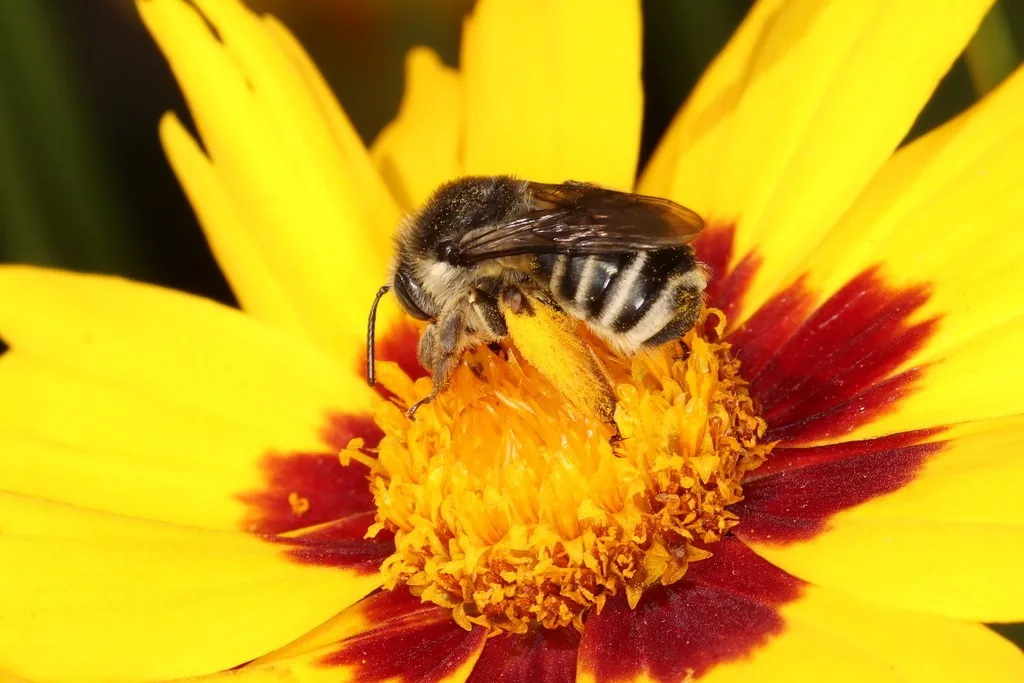
- Medium to large (one-half to three-quarters of an inch), hairy, usually brown or gray with pale stripes.[1][2]
- Very long antennae, especially on males, and light gray or blue eyes; many species have yellow faces.[1][2][4]
- Often found resting inside squash blossoms during the day, or on sunflowers and other composites.[1]
- Nest holes in the ground, sometimes with more than one female using the same entrance.[1]
Look-alikes
| Look-alike | How to tell them apart |
|---|---|
| Common long-horned bee (Melissodes communis) | One widespread eastern species in this tribe; this page covers the whole group.[2] |
| Squash bees (Peponapis and Xenoglossa) | Also in the tribe Eucerini, but they collect pollen only from squash, gourds and pumpkins and work the flowers very early in the morning. A 2018 revision moved both into the genus Eucera as subgenera.[2][6] |
| Digger bees (Anthophora) | Large, hairy, usually gray bees with bold stripes and proportionally small wings that hover low and fly fast; they also nest in the ground, often in large groups, and many species build a mud chimney over the burrow.[1][4] |
| Honey bees and bumble bees | In the same family, but honey bees and bumble bees live in colonies, whereas long-horned bees are solitary ground nesters with much longer antennae.[2][1] |
Where it lives
More than 200 species of the tribe occur in North America north of Mexico; Missouri and Utah both list them among their common native bees. GBIF holds about 150,000 US records of Melissodes and Eucera since 1990 from 48 states, counting the District of Columbia, most from Pennsylvania, Colorado and California.[2][1][9][10]
Biology and life cycle
Females dig relatively deep tunnels in the ground as nest sites. They are solitary, though they sometimes share a nest entrance. Underground, the branched tunnels end in brood cells, each stocked with pollen and nectar and holding one egg; the larvae feed on the bright orange pollen masses.[1][3]
Most long-horned bees visit particular plants. The worthy longhorn, for example, pollinates pickerel weeds along lake and pond shores, and the squash bees in the same tribe collect pollen only from squashes, gourds and pumpkins.[2][4]
They are important pollinators of squashes, pumpkins, melons, sunflowers and native wildflowers, and can be seen throughout the day resting in squash blossoms.[1]
In Utah they fly from May to September, with peak activity in July and August.[1]
Nests are raided by longhorn-cuckoo bees (Triepeolus), which wait near an unguarded Melissodes nest for the chance to enter and lay their own eggs.[3][4]
Missouri lists one long-horned bee, Melissodes intorta, a specialist on poppy mallows that bloom only a few weeks a year in prairies, as a species of conservation concern.[4]
Damage and signs
Health risk
Solitary bees like these are not aggressive and are only likely to sting if mishandled or stepped on with bare feet; males have no stinger. For a sting, MedlinePlus advises washing the site with soap and water and applying wrapped ice 10 minutes on and 10 minutes off; call 911 for trouble breathing, wheezing or swelling of the face, mouth or throat, which can signal a life-threatening allergic reaction.[4][3][5]
Control
Prevention
No control is needed. Leave the ground nests alone; long-horned bees are solitary, not aggressive, and pollinate squash, sunflowers and wildflowers.[2][1][4]
Where sources disagree
Specialists or generalists? The Missouri Department of Conservation says most long-horned bees visit very particular plants. A Texas study of pollen loads found Melissodes tepaneca foraging as a generalist, and a 2021 study notes that eucerine bees vary widely in their flower ties.[4][7][8]
Genus names: Missouri and many guides list squash bees as Peponapis and Xenoglossa; a 2018 revision of the Eucera complex reduced Peponapis, Xenoglossa and Tetralonia to subgenera of an expanded Eucera, so the same bees appear under both names.[2][6]
Common questions
- What is the fuzzy bee with the really long antennae?
- A male long-horned bee. The tribe is named for the males' long antennae; the bees are hairy, brown or gray with pale stripes, and have pale gray or blue eyes.[2][1]
- Why do I find bees asleep inside my squash flowers?
- Long-horned bees, including the squash bees in the same tribe, rest in squash blossoms during the day. They are among the most important pollinators of squash, pumpkins and melons.[1][2]
- Do long-horned bees sting or swarm?
- They don't swarm: they are solitary ground nesters, though females sometimes share an entrance. Females can sting if handled or stepped on barefoot; males can't sting at all.[1][4][3]
Sources
- Utah State University Extension, “Beginner's Guide to Common Native Bees (May 2021).” extension.usu.edu/planthealth/research/beginners-guide-to-common-native-bees.php (accessed 2026-11-11)
- Missouri Department of Conservation, “Longhorn Bees (Field Guide).” mdc.mo.gov/discover-nature/field-guide/longhorn-bees (accessed 2026-11-11)
- USDA Forest Service and Pollinator Partnership, “Bee Basics: An Introduction to Our Native Bees (Beatriz Moisset and Stephen Buchmann).” www.fs.usda.gov/wildflowers/pollinators/documents/BeeBasics.pdf (accessed 2026-11-11)
- Missouri Department of Conservation, “Apid Bees (field guide).” mdc.mo.gov/discover-nature/field-guide/apid-bees (accessed 2026-11-11)
- MedlinePlus, U.S. National Library of Medicine, “Insect bites and stings (Medical Encyclopedia).” medlineplus.gov/ency/article/000033.htm (accessed 2026-11-11)
- Molecular Phylogenetics and Evolution, via PubMed, “Phylogeny, new generic-level classification, and historical biogeography of the Eucera complex (Dorchin et al. 2018).” pubmed.ncbi.nlm.nih.gov/29122650/ (accessed 2026-11-11). Cited from the PubMed abstract.
- Environmental Entomology, via PubMed, “Generalist behavior describes pollen foraging for perceived oligolectic and polylectic bees (Ritchie et al. 2016).” pubmed.ncbi.nlm.nih.gov/27271950/ (accessed 2026-11-11). Cited from the PubMed abstract.
- Proceedings of the Royal Society B, via PubMed, “Bee flowers drive macroevolutionary diversification in long-horned bees (2021).” pubmed.ncbi.nlm.nih.gov/34547912/ (accessed 2026-11-11). Cited from the PubMed abstract.
- Global Biodiversity Information Facility (GBIF), “Melissodes: US occurrence records since 1990 by state (GBIF occurrence search API).” api.gbif.org/v1/occurrence/search?taxonKey=5040596&country=US&hasGeospatialIssue=false&occurrenceStatus=PRESENT&year=1990%2C2026&facet=stateProvince&facetLimit=400&limit=0 (accessed 2026-11-11). State counts are records reported (iNaturalist research-grade, museum specimens, surveys), not abundance.
- Global Biodiversity Information Facility (GBIF), “Eucera: US occurrence records since 1990 by state (GBIF occurrence search API).” api.gbif.org/v1/occurrence/search?taxonKey=1340870&country=US&hasGeospatialIssue=false&occurrenceStatus=PRESENT&year=1990%2C2026&facet=stateProvince&facetLimit=400&limit=0 (accessed 2026-11-11). State counts are records reported (iNaturalist research-grade, museum specimens, surveys), not abundance.
- iNaturalist, “Eucerini taxon page (order and family).” www.inaturalist.org/taxa/121514 (accessed 2026-11-11)