The short answer
- Seal the way in: weather-strip doors and windows, fit tight door sweeps, caulk around eaves and pipes, and keep screens tight. A bark scorpion needs only a crack of 1/16 inch to enter a home.[3][1][4]
- Take away hiding places next to the house: rocks, boards, bricks, logs, firewood, trash and other clutter.[3][4][1][2]
- Hunt them at night with a UV (black) light. Scorpions glow under it, so you can find them and remove them with long tongs into a sealed jar.[3][1][2]
- Put sticky traps along wall edges and under furniture for nontoxic, longer-term catches.[5][3]
- If you spray, treat the foundation and entry points as a supplement. University sources say scorpions can't be managed with pesticides alone.[2][4][3][5]
- For a sting, call Poison Help at 1-800-222-1222. For a young child, or anyone with trouble breathing, drooling, or twitching or roving eyes, call 911 or Poison Help or go to the hospital right away.[6][1][8]
Scorpions
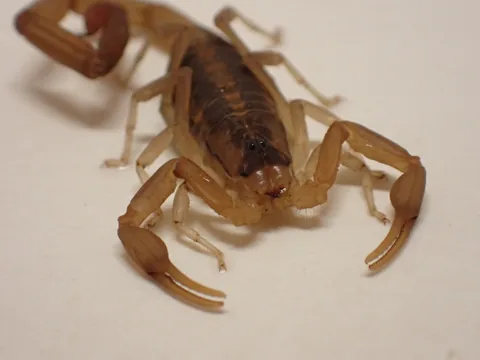 Scorpions
Order Scorpiones (shown: striped bark scorpion, Centruroides vittatus)
Scorpions are arachnids, relatives of spiders, ticks and mites, that hide by day and hunt insects at night. They live across the southern United States, and most U.S. stings are reported from Arizona, Texas and Nevada.
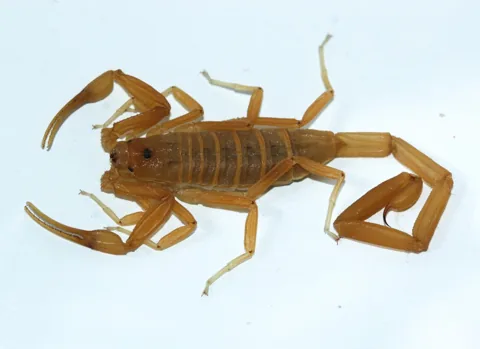 Arizona Bark Scorpion
Centruroides sculpturatus
The Arizona bark scorpion is a slender, climbing scorpion of the desert Southwest that often lives in and around homes. It is the only scorpion in the United States whose sting is considered a medical concern.
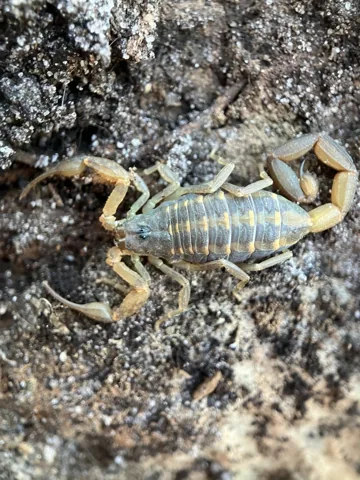 Hentz Striped Scorpion
Centruroides hentzi
The Hentz striped scorpion is one of the three scorpions seen most often in Florida, and it occurs statewide there. Researchers who analyzed its venom describe it as a Centruroides species that poses no serious threat to people, though a sting still hurts.
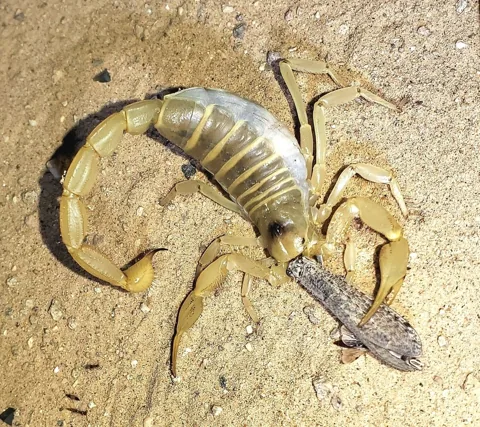 Giant Desert Hairy Scorpion
Hadrurus arizonensis
The giant desert hairy scorpion, also called the Arizona giant hairy scorpion, is the largest scorpion in the United States. Despite its size, its venom is mild, and extension entomologists consider it harmless and even beneficial.
Which scorpions you're dealing with
All native scorpions can sting, but extension and poison-center sources agree that only one U.S. species is regarded as dangerous: the Arizona bark scorpion, Centruroides sculpturatus. The rest give a sting that UC IPM compares to a bee sting.[1][6][3][2]
Scorpion stings reported to U.S. poison control centers from 2005 to 2015 came mostly from Arizona (68.2%), Texas (10.3%) and Nevada (4.2%), and six other southern states reported more than 100 cases a year.[9]
- Arizona bark scorpion: adults are 2 to 3 inches long with slender pincers and a long, thin tail. Color varies from pale to darker with stripes. It is a climber that does not normally burrow, lives under bark and in rock crevices and walls, and is the scorpion most likely to get into homes. Its range covers Arizona and small parts of California, Nevada, New Mexico, Utah, Colorado and Texas.[1][3][2]
- Striped bark scorpion (Centruroides vittatus): the most common scorpion in Texas, about 2½ inches long, yellowish tan with two broad dark stripes down the back and a dark triangle on the head. It climbs trees and walls, is often found in attics, and may move into living areas to escape hot attics. Texas A&M says stings from Texas scorpions produce only moderate reactions in most people.[4]
- Arizona giant hairy scorpion (Hadrurus arizonensis): the largest U.S. scorpion, often over 5 inches long. It burrows and hides under rocks; the University of Arizona says its venom is mild and that it eats bark scorpions.[1][3]
- Stripe-tailed and ground scorpions (Vaejovis and Paravaejovis): small burrowing desert scorpions often mistaken for bark scorpions, but with bulkier pincers or tails. Their venom is relatively mild.[1][3]
- Southern devil scorpion: the scorpion of the Southeast, up to 2-5/8 inches long, found around rocky hillsides, brick walls, crawl spaces and log piles. In Kentucky it is seen in or around houses most from April through June, and the sting usually hurts for 15 to 20 minutes.[5]
Why scorpions end up in the house
Homes give scorpions food, water and shelter. Bark scorpions feed on crickets, cockroaches and other insects, and the University of Arizona says irrigated yards can support far more of them than desert land does. A cricket or cockroach problem indoors can bring more scorpions inside.[1][2]
They come in under and around poorly fitted doors, through window and attic vents, cracks in foundations, gaps around plumbing, and weep holes. Once inside a wall void, bark scorpions can reach rooms around electrical faceplates and pipe collars.[1][3]
In a University of Arizona telemetry study, 95% of the bark scorpions' use of structures was in hollow block walls, which they preferred over plants, debris or burrows.[10][1]
- Bark scorpions climb walls and cross ceilings, then fall into beds, sinks and bathtubs they can't climb out of.[1]
- Most movement happens from 7pm to 11pm and from 3am to sunrise. Light, extreme heat, flooding after irrigation or monsoon rains, and construction all make them move.[1][2]
- They are less active from November to March and gather in groups to overwinter in protected spaces such as block walls.[1]
Step 1: Seal entry points
Pest-proofing is, in the University of Arizona's words, by far the most effective way to cut down scorpion contact and stings. Kentucky Extension suggests doing the sealing and cleanup in fall or winter, before scorpions become active in spring.[1][5]
- Install weather-stripping around doors and windows and make sure door sweeps fit tight with no gaps.[1][3][4][5]
- Caulk or seal around roof eaves, pipes, wires and any other wall penetrations.[1][3][4][5]
- Keep window screens in good repair and tight in their frames.[1][3][4]
- Cover weep holes in brick veneer or stucco weep screed with mesh. The University of Arizona says to use coarse steel mesh and not to seal them shut, since they ventilate the wall; Texas A&M lists copper mesh, nylon scouring pad, screen wire or steel wool (steel wool rusts, so use it only on dark facades).[1][4]
- Stucco and cap hollow-block walls so they are less inviting as shelter.[1]
Step 2: Remove hiding places and prey
Scorpions hide by day under objects and in crevices and come out at night to hunt. Dense ground cover, leaf litter, mulch, wood piles and clutter shelter both scorpions and the insects they eat.[5][7][3]
- Clear trash, logs, boards, stones, bricks and other objects away from the foundation.[3][4][1][6]
- Keep grass mowed short near the house, cut back low ground cover, and prune shrubs and tree branches away from the walls and roof. Branches give scorpions a path to the roof.[1][4][3][6]
- Store firewood outdoors and bring in only what goes straight onto the fire, checking it first.[3][4][1]
- Set garbage cans in a frame that holds them above ground level.[1][4]
- Use yellow outdoor lights where scorpions are common; they draw fewer of the insects scorpions hunt.[3]
- Cutting down crickets and other insects helps, but the University of Arizona notes it won't remove scorpions from around a home on its own.[1]
Step 3: Find them at night with a blacklight
Scorpions glow brightly under ultraviolet light, so a portable UV flashlight shows them from several yards away. The University of Arizona suggests checking indoors before bedtime and doing UV collections several times during the summer between 8 and 11pm.[1][2][3]
- Wear boots and use long tongs or forceps. UC IPM says forceps 10 to 12 inches long work, or trap the scorpion under a glass jar and slide stiff paper underneath, then screw on a lid.[1][3][2]
- Never look directly into an ultraviolet light; it can damage the eyes.[2]
- The University of Arizona asks people to consider releasing captured scorpions in natural desert rather than killing them, since they are predators in the local ecosystem.[1][2]
Step 4: Sticky traps and other barriers
Kentucky Extension says sticky boards placed along wall edges and under furniture can catch scorpions and give relatively long-term, nontoxic control. UC IPM also lists glue boards as useful for trapping scorpions.[5][3]
Step 5: Where insecticides fit (and their limits)
Extension sources from Arizona, California and Texas agree that scorpions are hard to control with insecticides alone. They spend the day in cracks where sprays don't reach, and UC IPM notes adults are harder to kill because of their larger size and thicker cuticle. The University of Arizona adds that eliminating scorpions from a landscape with chemicals would take extremely unhealthy and illegal pesticide use and would still be temporary.[3][1][2][4]
If you do treat, use a product labeled for scorpions on the outside of the house. UC IPM and Texas A&M say to treat the foundation and up to 1 foot of the exterior wall, plus doors, window eaves and other entry points. Kentucky Extension suggests longer-lasting pyrethroid liquids at the base of doors, vents and utility openings and under siding, and possibly a band 2 to 6 feet wide along the ground and 2 to 3 feet up the foundation wall.[3][4][5]
- Synthetic active ingredients Texas A&M lists for scorpions are permethrin, cyfluthrin, cypermethrin, lambda-cyhalothrin, deltamethrin, bifenthrin and carbaryl. Plant-oil products (rosemary, cinnamon, clove, thyme, peppermint) and pyrethrum break down faster and may not give long control.[4]
- Indoors, Texas A&M says to direct treatments at entry points, corners, cracks and crevices where scorpions hide.[4]
- Don't overapply. UC IPM warns against overusing pesticides out of frustration when they seem slow at label rates, and against using them without the other steps. Read and follow the label.[3][5]
Avoiding stings at home
Most stings happen when a scorpion is grabbed, crushed against the body or stepped on. In poison-center data, 97.8% of stings happened at a home, and the Arizona poison center says most occur at night in the warm summer months.[1][9][6]
- Wear shoes outdoors at night and slippers indoors at night where bark scorpions live.[1][3][2]
- Shake out shoes, clothing and towels before using them, and don't leave shoes, clothes or wet towels on the floor or outdoors. Damp pool towels draw scorpions looking for moisture.[1][3][7][5]
- Wear leather gloves when moving rocks, wood or debris.[2][7][3]
- Teach children not to touch scorpions and to tell an adult when they see one.[1][2]
- Don't assume a scorpion in a pool is dead. Bark scorpions can survive submerged in chlorinated water and still sting when fished out by hand.[1]
- Brush a scorpion off your body rather than swatting it.[5]
If someone is stung
Call the Poison Help hotline at 1-800-222-1222. It reaches your local poison center from anywhere in the U.S., is free and confidential, and works 24 hours a day. A specialist will tell you whether the person can stay home or needs to go to the hospital.[6][8][1]
A sting usually causes immediate burning pain with little swelling. Numbness and tingling are frequently reported and may spread across the body, and the area may be very sensitive to touch, pressure, heat and cold. Most stings in healthy adults can be managed at home, and about 90% of stings reported to the Arizona poison center are treated at home.[6][7][1][9]
Small children are at the highest risk of severe reactions. MedlinePlus says children 6 years and younger are more likely to have harmful effects, and the University of Arizona's guidance is to call 911 or Poison Help, or go to the nearest hospital immediately, if a child 9 years or under or weighing less than 70 pounds is stung. Infants who cry inconsolably may have been stung.[6][8][1]
- First aid from the Arizona poison center: clean the site with soap and water, apply a cool compress, rest the limb in a comfortable position, and use over-the-counter pain medicine as needed.[6][1]
- For ice or a cold pack, MedlinePlus says to wrap it in a cloth and use 10 minutes on, 10 minutes off. NIOSH says not to submerge the area in ice water.[8][7][1]
- Stay calm and don't take sedatives or alcohol.[7][3]
- Loosen clothing and remove rings and tight jewelry. MedlinePlus says diphenhydramine by mouth may be used alone for mild symptoms if the person can swallow.[8]
- If it is safe, capture the scorpion or take a photo of it so it can be identified, and note the time and location of the sting.[7][8][3]
Signs that need emergency care
Bark scorpion venom affects the nervous system. Warning signs include roving or jerky eye movements, muscle twitching, flailing or jerking limbs, slurred speech or a thick-feeling tongue, drooling or frothing at the mouth, trouble breathing, restlessness and convulsions.[1][7][8][6]
According to the University of Arizona, symptoms generally develop within 20 minutes and keep worsening during the first 4 hours. MedlinePlus says a rapid worsening within the first 2 to 4 hours points to a poorer outcome.[1][8]
An antivenom (Anascorp) is available in some hospitals for severe cases, and the University of Arizona says symptoms usually resolve within 4 hours of treatment. Deaths are rare in the United States.[1][3]
- Most healthy adults recover within a day or two, though pain, numbness and tingling can last several days. The University of Arizona recommends seeing a doctor if symptoms last beyond a week.[1]
- People with high blood pressure, the elderly and anyone allergic to scorpion venom also need prompt care.[1][3][4]
- Pets are at risk too: the University of Arizona notes that cats are not immune to bark scorpion venom.[1]
When to call a professional
If you regularly find scorpions inside, the University of Arizona recommends a pest management professional experienced with scorpions; many companies also offer pest-proofing services. Even then, expect to keep up the sealing and cleanup, because scorpions are extremely difficult to eradicate.[1]
Common questions
- What kills scorpions in the house?
- No spray reliably does it alone. Sealing entry points, removing hiding places, sticky traps and nighttime blacklight checks do most of the work; a labeled insecticide around the foundation and entry points can supplement them.[3][2][4][5]
- Are all scorpions in the U.S. dangerous?
- No. Only the Arizona bark scorpion is regarded as dangerous. Other U.S. scorpions can give a painful sting, comparable to a bee sting, and allergic reactions are possible.[1][3][6][4]
- Do blacklights really find scorpions?
- Yes. Scorpions fluoresce under UV light and can be spotted from several yards away, which is why extension specialists recommend blacklight checks at night.[2][1][3]
- Do glue traps work on scorpions?
- They can. Kentucky Extension calls sticky boards along walls and under furniture a relatively long-term, nontoxic control, and UC IPM lists glue boards for trapping scorpions.[5][3]
- What should I do if I'm stung by a scorpion?
- Wash the site with soap and water, use a cool compress, and call Poison Help at 1-800-222-1222. Get emergency care right away for a young child or for trouble breathing, drooling, twitching or abnormal eye movements.[6][8][1][7]
- How do scorpions get into the house?
- Under poorly fitted doors, through vents, foundation cracks, plumbing gaps and weep holes, and inside firewood. Bark scorpions need a gap of only 1/16 inch.[1][3][2]
Photo credits
- Scorpions: (c) dhasdf, some rights reserved (CC BY) — via iNaturalist, CC BY 4.0
- Arizona Bark Scorpion: (c) Andrew Meeds, some rights reserved (CC BY) — via iNaturalist, CC BY 4.0
- Hentz Striped Scorpion: mikoikoi, public domain (CC0), via iNaturalist
- Giant Desert Hairy Scorpion: (c) Bob Miller, some rights reserved (CC BY) — via iNaturalist, CC BY 4.0
Sources
- University of Arizona Cooperative Extension, “Scorpions of the Desert Southwest United States (AZ1768).” extension.arizona.edu/sites/extension.arizona.edu/files/pubs/az1768-2018.pdf (accessed 2026-11-10)
- University of Arizona Cooperative Extension, Yavapai County, “Backyard Gardener #184: Scorpions.” www.extension.arizona.edu/sites/extension.arizona.edu/files/attachment/Scorpions.pdf (accessed 2026-11-10)
- University of California Statewide IPM Program, “Scorpions (Pest Notes).” ipm.ucanr.edu/home-and-landscape/scorpions/ (accessed 2026-11-10)
- Texas A&M AgriLife Extension, “Scorpions (ENTO-PU-032).” extensionentomology.tamu.edu/wp-content/uploads/2025/03/scorpions.pdf (accessed 2026-11-10)
- University of Kentucky Entomology, “Scorpions in Kentucky (EF633).” entomology.mgcafe.uky.edu/ef633 (accessed 2026-11-10)
- Arizona Poison and Drug Information Center, “Scorpions.” azpoison.com/venom/scorpions (accessed 2026-11-10)
- CDC, National Institute for Occupational Safety and Health, “Insects and Scorpions at Work.” www.cdc.gov/niosh/outdoor-workers/about/insects-and-scorpions.html (accessed 2026-11-10)
- NIH National Library of Medicine, MedlinePlus, “Scorpions (Medical Encyclopedia).” medlineplus.gov/ency/article/002850.htm (accessed 2026-11-10)
- Journal of Medical Toxicology (PubMed 27921219), “Kang AM, Brooks DE. Nationwide scorpion exposures reported to US poison control centers from 2005 to 2015. J Med Toxicol 2017;13(2):158-165.” pubmed.ncbi.nlm.nih.gov/27921219/ (accessed 2026-11-10)
- Environmental Entomology (PubMed 25203773), “Bibbs CS, Bengston SE, Gouge DH. Exploration of refuge preference in the Arizona bark scorpion. Environ Entomol 2014;43(5):1345-53.” pubmed.ncbi.nlm.nih.gov/25203773/ (accessed 2026-11-10)