On this page
How to identify it
Look-alikes
| Look-alike | How to tell them apart |
|---|---|
| Other Neoscona and Araneus orbweavers | Related orbweavers, including the arabesque orbweaver and Araneus species such as the marbled orbweaver, are hard to tell apart, even for specialists.[2] |
Where it lives
Found from southern Florida north to New England, west to Minnesota and southwest to Arizona and Mexico; MDC calls it the most common Neoscona in Missouri.[1][2]
Biology and life cycle
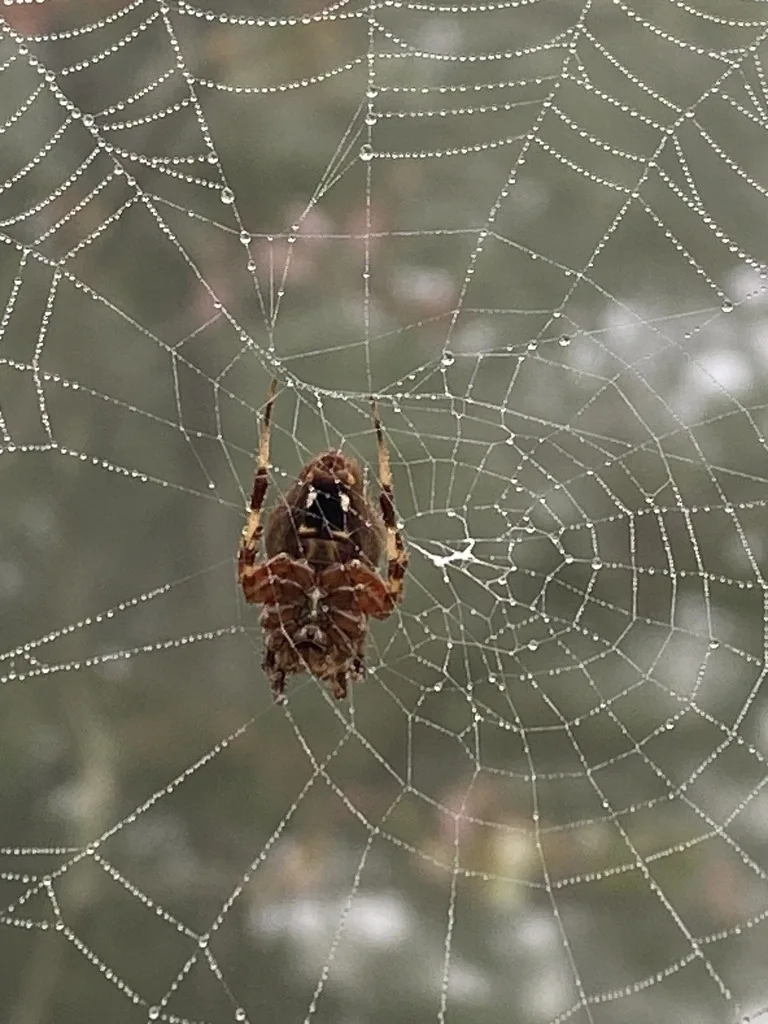
Females build the web at dusk, hunt at night, eat the web at dawn and hide in cracks and corners by day.[2]
In the North males mature as early as late June and females in July; adults are most noticeable in late summer and fall.[1]
Damage and signs
Health risk
UF reports its bites are not known to cause serious problems.[1]
Control
Prevention
No control is needed; the spider takes its web down at dawn and rebuilds at dusk.[2]
Common questions
- What is the big brown spider that makes a web on my porch every night?
- Likely a spotted orbweaver, which builds its web at dusk and eats it at dawn.[1][2]
- Is the spotted orbweaver dangerous?
- No; bites aren't known to cause serious problems.[1]
- Where does it go during the day?
- It hides in nearby cracks and corners.[2]
Sources
- University of Florida IFAS Extension (EDIS, Featured Creatures), “Orb Weavers, Neoscona crucifera and Neoscona domiciliorum (EENY-316/IN569).” ask.ifas.ufl.edu/publication/IN569 (accessed 2026-10-15)
- Missouri Department of Conservation, “Arboreal Orbweaver (Spotted Orbweaver) (Field Guide).” mdc.mo.gov/discover-nature/field-guide/arboreal-orbweaver-spotted-orbweaver (accessed 2026-10-15)
- iNaturalist, “Neoscona crucifera taxon page (order and family).” www.inaturalist.org/taxa/85034 (accessed 2026-10-06)