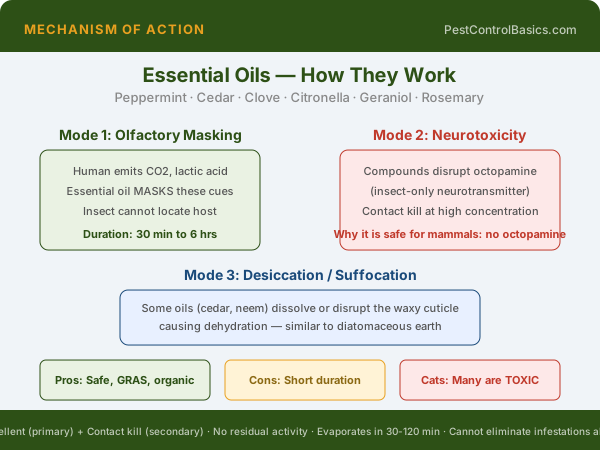
Essential oils like peppermint, cedar, clove, and citronella have real pest-repelling properties — but their effectiveness varies enormously by oil type, concentration, pest species, and application method. Here's what the science actually says, with no hype and no dismissal.
Generally recognized as safe (GRAS) when used properly. Many are EPA 25(b) exempt — meaning EPA considers them minimal risk. However, "natural" does not automatically mean "safe."
⚠️ Important cautions: Many essential oils are toxic to cats (especially tea tree, peppermint, citrus oils). Some can cause skin sensitization with repeated contact. Always dilute properly — undiluted essential oils can burn skin. Keep away from eyes.
⚠️ Cats: Cats lack a key liver enzyme (glucuronyl transferase) needed to metabolize many essential oils. Tea tree, peppermint, eucalyptus, and citrus oils can be toxic to cats even in diffused form.
Example
0.5 oz
per gallon
⚗️ Mixing Calculator
Enter your sprayer size and target rate — get the exact amount to pour. Backpack, hand sprayer, hose-end, or skid unit.
The honest truth: Essential oils work as repellents — the scientific evidence is clear on this. Where they fall short is as killers. They repel pests but rarely eliminate infestations. Think of them as a first line of defense, not a total solution.
Best use cases: Prevention and repelling in low-pressure situations. Keeping spiders out of a clean garage. Deterring ants from a countertop. Repelling mosquitoes during a short outdoor event. NOT for: active infestations, termites, bed bugs, or any situation where elimination is needed.
Duration problem: Most essential oils evaporate within 30-60 minutes. You need frequent reapplication, or use formulations with fixatives that slow evaporation. This is their biggest practical limitation compared to synthetic repellents.
🐛 Pests This Treats — Learn More
Click any pest to view its full identification guide, biology, and treatment options.
Follow the product label. Keep pets out of treated areas until completely dried (2–4 hours for sprays). Once dry, treated surfaces pose minimal risk to dogs and cats.
Q: Can I use essential oils pest control indoors?
Check the specific product label — formulations vary. Baits and dusts often have indoor labeling; concentrates and granulars are typically outdoor.
Q: How long does essential oils pest control last after application?
Residual varies by formulation, surface type, weather, and UV exposure. Indoor applications last longer than outdoor. Check the product label for re-application intervals.
Q: What should I do if exposed?
Remove contaminated clothing, wash skin with soap and water. For eye contact, rinse 15–20 minutes. For ingestion or severe symptoms, call Poison Control (1-800-222-1222). Have the product label available.
📋 Safety Data Sheet (SDS)
📋
Essential Oils for Pest Control — Safety Data Sheet
View the official SDS document for this product directly on the CDMS label database.
💡 Did you know? The EPA exempts certain essential oil pesticides from registration under FIFRA Section 25(b) because they're considered minimum risk. This means they can be sold without full EPA testing — which is good for access but means some products haven't been rigorously tested for efficacy.
🔮
Reviewed by Derek GiordanoContent reviewed by a licensed pest management professional. Last reviewed: April 2026.
Known limitations of Essential Oils for Pest Control
No active ingredient is universal, and Essential Oils for Pest Control has specific weak points worth understanding before purchase. Resistance is the most common limitation — populations in heavily-treated areas (commercial kitchens, multi-unit housing, urban cores) often show measurable tolerance compared to populations in less-treated environments. Rotating between chemical classes every two or three applications reduces resistance pressure significantly.
Substrate binding is another limitation. Essential Oils for Pest Control on highly absorbent surfaces like unfinished wood or carpet can become bound to the substrate within hours of application and never reach the pest in active form. For these surfaces, dust formulations or baits perform better than liquid sprays. Crack-and-crevice application using a precision tip places product where it reaches the pest while minimizing exposed-surface residue.
Pollinator and beneficial-insect impact is the third limitation to plan around. Outdoor application timing should avoid blooming plants, and any application near beneficial habitat (gardens, water features, pollinator strips) should be made in late evening when beneficials are inactive.
Practical safety considerations for Essential Oils for Pest Control
The label is the law, and it covers the legal minimum. Practical safety for Essential Oils for Pest Control in a household setting goes beyond label compliance — children, pets, and food-contact surfaces all merit precautions above the regulatory floor. Re-entry intervals on consumer labels are typically calibrated for healthy adults; for nurseries, pet bedding areas, and pregnant-occupant homes, doubling the indicated interval is a reasonable default.
Ventilation matters more than most homeowners realize. Even low-VOC formulations release detectable airborne residues for several hours post-application, and an HVAC system that is running during treatment will redistribute those residues throughout the structure. Standard practice is to turn off forced air for the treatment window and the first hour after, then run on high circulation for 30 minutes before normal occupancy resumes.
Personal protective equipment listed on the label is the minimum. For larger volumes, a half-face respirator with organic-vapor cartridges adds meaningful protection at modest cost. Nitrile gloves outperform latex for solvent-based formulations and are inexpensive enough to use single-use.
Comparing Essential Oils for Pest Control to alternatives
Choosing between Essential Oils for Pest Control and a comparable product usually comes down to four factors: speed of kill, residual length, target spectrum, and household-sensitivity profile. No single product wins on all four — fast-acting contact kills typically have short residuals, while long-residual products often act slowly enough that homeowners assume they have failed within the first 48 hours. Matching the product to the situation is more important than picking the strongest available option.
Cost per application is a useful but incomplete metric. A cheaper concentrate that requires more frequent reapplication often costs more per season than a more expensive product with a longer effective window. Coverage area per gallon at the label rate is the better comparison number, and it is usually printed clearly on the label.
For most households, keeping two complementary products — one fast-acting and one long-residual, ideally from different chemical classes — covers more situations than a single all-purpose product and supports the resistance-management rotation noted above.
Published: Jan 1, 2025 · Updated: Apr 7, 2026
Storage and disposal of pesticide products
Pesticide storage and disposal practices have meaningful safety and environmental implications that many homeowners overlook. Storage practices that matter: keep products in original containers with intact labels (decanting is a documented poisoning cause and makes label-required information unavailable when needed), store in a locked area or cabinet inaccessible to children and pets, separate from food and animal feed, in a temperature-controlled location (extreme cold and extreme heat both degrade many products), and elevated above floor level to prevent contamination from spills. Disposal practices: never pour unused products down drains, on the ground, or into household trash; consult the label disposal instructions and your municipality's household hazardous waste program (most jurisdictions have collection events or permanent sites), and use up small remaining quantities at label rates rather than disposing of partial containers when possible. Empty containers, after triple rinsing as the label specifies, can typically go in recycling or trash per the label, but rinsate must be applied as the original product would be.
Why pest control timing should match local biology, not national calendars
Generic pest control timelines published nationally are useful starting points but rarely match local conditions. The same pest emerges weeks earlier in the South than the upper Midwest, peaks at different times in coastal versus inland regions, and finishes its season at different points depending on first frost. Local cooperative extension services publish region-specific phenology — degree-day models, first-detection dates, peak activity windows — that align treatment timing with the pest's actual biology in your area. Beekeepers, gardeners, and Master Naturalist programs locally often track these timings informally and publish them on club websites. The benefit of matching local biology is significant: a preventive treatment applied three weeks early loses most of its value, and one applied three weeks late may miss the highest-pressure window entirely. The thirty minutes spent finding accurate local timing repays itself across every treatment that follows.
Application timing within the day and weather conditions
Pesticide applications produce significantly different results depending on application timing, and matching application to conditions improves outcomes substantially. For outdoor liquid applications, early morning (after dew has evaporated, before pollinators are active) and late evening (after pollinators have stopped foraging, before evening dew) produce best results: temperatures are moderate, wind is typically lower, and non-target exposure is reduced. Mid-day applications during high temperatures cause volatility losses and faster degradation. For interior treatments, timing depends on the pest: cockroach baiting works at any time but should follow rather than precede cleaning; bed bug treatments need to follow vacuuming and clutter reduction; ant baits work best when active trails are present, which often means specific times of day for specific species. Rain within 4 hours of outdoor liquid application washes off most surface residue except specifically rainfast formulations; checking the next 24-hour forecast before any outdoor treatment is the basic discipline that prevents this loss. Temperatures above 90°F or below 50°F outside the product label's recommended range produce reduced efficacy.
Reading product labels: the parts that matter and the parts that don't
Pesticide product labels are legal documents with specific use directions, but the parts that matter most for residential decisions aren't always the parts that get attention. The active ingredient and its concentration are essential — they determine what category of pest the product targets and how it compares to alternatives. The 'Directions for Use' section is binding (using a product against label instructions is technically a federal violation and may void product liability), but most homeowners skim it. The 'Precautionary Statements' section tells you exposure risks and required PPE. The 'First Aid' section matters in an emergency. What matters less in practice: marketing copy on the front of the package, brand-specific claims about superiority (federal regulations sharply limit what these can say), and 'natural' or 'organic' labeling (which can be technically accurate while still describing a product with meaningful exposure considerations — pyrethrin from chrysanthemums is 'natural' but still a neurotoxin in concentration). Reading labels critically — focusing on active ingredient, concentration, target pest list, application method, and precautions — gives a clearer picture than retail-shelf comparison ever does.
Pesticide rotation and the resistance management problem
Resistance management — using multiple active ingredients in sequence so that no single mode of action selects for resistant individuals — is standard practice in agricultural and commercial pest control but rarely makes it into residential treatment decisions. The underlying concern is real: chronic use of a single pyrethroid product against bed bugs has produced widespread pyrethroid resistance, with some populations now showing resistance factors of 1000x or more. The same pattern is documented in German cockroach resistance to chlorpyrifos and other historical actives, mosquito resistance to organophosphates in heavy-use regions, and house fly resistance across multiple compound classes. For residential treatment, the practical implication is to avoid using the same active ingredient repeatedly across multiple treatment cycles; rotating between products in different chemical families (e.g., pyrethroid → neonicotinoid → insect growth regulator → carbamate, or whatever subset is appropriate to the target pest) reduces selection pressure and preserves efficacy. The product label specifies the active ingredient family, allowing rotation choices to be made on actual chemistry rather than brand name.
Pesticide drift and the neighbor dimension
Pesticide drift — the off-target movement of applied product through air, water, or runoff — is an under-discussed dimension of residential pesticide use, but it's an increasingly common source of conflict between neighbors and a real factor in the cumulative environmental load of pesticide use. Foliar sprays applied in even light wind drift further than most homeowners expect, particularly with finer droplet sizes. Granular products applied near property lines wash into adjacent properties in significant rainfall. Mosquito fogging can move across multiple properties depending on conditions. The implications are partly legal — drift onto neighboring property without consent has been the basis of successful nuisance claims in some jurisdictions — and partly ethical. Applying products only in low-wind conditions, choosing coarser droplet sizes when possible, using granulars rather than sprays near property lines, and timing applications to avoid imminent rainfall all reduce drift. For homeowners concerned about pesticide exposure from neighbors' applications, the productive conversation is usually about timing and product choice rather than about pesticide use in general, and approaching it that way tends to produce cooperation rather than escalation.
Pet-safe pest control: what the label actually communicates
Pet-safe is a marketing phrase that does specific work, and the work it does is narrower than most pet owners assume. A product labeled pet-safe is generally one that, when used according to label directions and after the specified re-entry interval, presents a low risk of acute toxicity to pets at expected exposure levels. That is not the same thing as zero risk, and it doesn't say anything about chronic exposure, behavioral effects, or exposure to pets with unusual physiology, age, or pre-existing conditions. The other thing it doesn't account for is real-world misuse: pets that lick treated surfaces immediately after application, products applied in higher concentrations than directed, or applications in locations the label didn't anticipate. The practical interpretation is that pet-safe products are a reasonable choice when used carefully, but the safer overall practice with any pet in the home is to keep animals out of treatment areas until products are fully dry or absorbed, choose lower-toxicity formulations like bait stations over surface sprays when feasible, and ask explicitly about ingredients and re-entry intervals rather than relying on the label phrase alone.
Reduced-risk pesticide selection: a category worth knowing
The EPA's reduced-risk pesticide program identifies active ingredients and formulations that meet specific criteria for lower toxicity to non-target organisms, reduced potential for groundwater contamination, lower likelihood of resistance development, or better compatibility with integrated pest management. Products in this category aren't free of toxicity — they're pesticides, and all pesticides have some toxic profile — but they represent the lower end of the risk distribution within their pest categories. For homeowners who want to use pesticides but are concerned about minimizing exposure and environmental impact, looking for products with reduced-risk actives is a defensible filter. Examples include some of the diamide insecticides, spinosyns, and certain microbial products. The catch is that retail availability lags behind the professional market for many reduced-risk products, and consumer pesticide aisles still skew heavily toward older pyrethroid and carbamate formulations. For homeowners willing to source products from agricultural supply channels or work with a pest control company that uses these products, the option exists; for those buying off the shelf at typical retail, the choices are narrower.