On this page
How to identify it
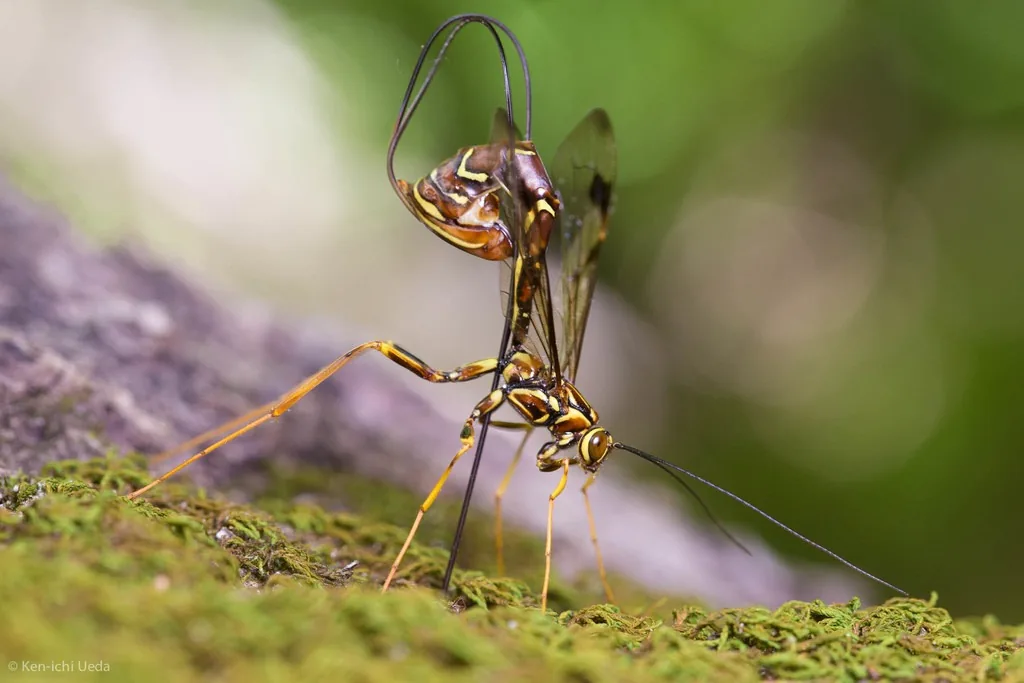
- Built like a stinging wasp but slenderer, with a long abdomen; adults usually measure 1/2 to 1 1/2 inches, though many species are much smaller.[1][2]
- Antennae usually at least half as long as the body, with 16 or more segments; the long, constantly moving antennae are a quick family clue.[1]
- Females usually carry a dramatically long ovipositor, a needle-like or thread-like appendage at the tip of the abdomen that is often longer than the body and is used to insert eggs into a host.[1][2]
- Colors vary widely: many species are drab, others brightly colored or patterned, and some wear black and yellow bands like stinging wasps.[1]
- Females are often seen walking over tree trunks and logs, tapping with their antennae to find wood-boring larvae under the bark.[1]
- Taxonomists increasingly call the family Darwin wasps. Many are active at night: one large genus of mostly nocturnal species, Enicospilus, holds more than 700 species worldwide, all parasitoids of moth and butterfly caterpillars.[6][7]
- A sign you can find without seeing the wasp: one common ichneumon, Hyposoter, leaves an oblong white cocoon about 1/4 inch long, blotched with black, stuck to the shriveled skin of the caterpillar it killed.[5]
Look-alikes
| Look-alike | How to tell them apart |
|---|---|
| Giant ichneumon wasps (Megarhyssa) | The biggest members of this family: the female black giant ichneumon has a body 1 1/2 inches long and an ovipositor about 5 inches long, which she drills through decaying wood to reach a pigeon tremex horntail larva.[1] |
| Braconid wasps | A second huge family of parasitic wasps, almost 20,000 species worldwide, treated together with ichneumons in the WSU fact sheet; both target caterpillars, beetles and flies, and both have long-ovipositored females.[2] |
| Paper wasps and other stinging wasps | Some ichneumons have black and yellow bands like stinging wasps, but ichneumons are slenderer, with much longer antennae and, on females, a long egg-laying filament rather than a stinger.[1] |
| Horntails | The wood-wasp hosts of giant ichneumons; a horntail female lays eggs in wood with a short, stout spike rather than a long thread-like ovipositor.[1] |
Where it lives
Ichneumons occur statewide in Missouri and are common in nearly all habitats; there are more than 5,000 species in North America and about 1,000 in the Pacific Northwest alone. GBIF's public U.S. records since 1990 for the family (about 107,000) come from 46 states on the map, most from Florida, California and Ohio.[1][2][8]
Biology and life cycle
Ichneumon larvae are mostly internal parasitoids of other insects' larvae, including beetle grubs, caterpillars of butterflies and moths, the young of ants, bees and wasps, flies, and spiders. The female uses her ovipositor to inject eggs into the host, usually a grub, caterpillar or pupa.[1]
The hatching larvae devour the host from the inside and usually kill it by the time they are ready to pupate, which is why they are called parasitoids rather than parasites. Many species require a particular species, genus or family of host.[1]
Females hunting wood borers wander over tree trunks, detect larvae below the bark with their antennae, then insert the long ovipositor through the wood to lay eggs in the larva. The young hatch, consume the host, pupate and emerge to repeat the cycle.[1]
Adults need nectar and pollen, so ichneumons and braconids are also incidental pollinators; how much they contribute is unknown, but their sheer numbers probably make them significant in some habitats.[2]
Counts of the family differ widely because so many species are undescribed. WSU gives more than 24,000 species worldwide; Missouri's conservation department gives an estimated 60,000 to 100,000, which would make it the largest family of any animals. For the Afrotropics, 2,322 species are recorded against an earlier estimate of almost 11,000.[2][1][6]
Hyposoter exiguae shows how the larvae work. The female lays one egg in a young caterpillar, usually an armyworm or cutworm; the larva first feeds on the host's blood, then eats everything but the skin and head capsule, and spins its cocoon on the dead host. In warm weather it goes from egg to adult in about a month and can have several generations a year.[5]
The name comes from Greek words for 'tracker' and 'footprint', because the females hunt down their hosts.[1]
Damage and signs
- Ichneumon wasps damage nothing. Their larvae kill insects before those insects reach the adult, reproductive stage, including many pests such as tomato hornworms, boll weevils and wood borers, and in many cases the insects they control are ones injurious to trees. UC IPM lists Hyposoter as important against caterpillars in alfalfa, cole crops, lettuce, peppers, strawberries, tomatoes and walnuts, with hosts including armyworms, cabbage loopers, corn earworms, cutworms and tobacco hornworms.[1][5]
Health risk
The long filament trailing behind a female is an egg-laying tube, not a stinger, and Missouri's conservation department describes ichneumons as mostly harmless to people despite their intimidating look. UC IPM goes further, saying the small to medium-sized parasitic wasps, ichneumons among them, are incapable of stinging people. WSU recommends no chemical management for this group.[1][4][2]
Control
Prevention
No control is needed: ichneumons are beneficial parasitoids that most people want in the garden. To keep them, grow native plants, which supply nectar, pollen and overwintering sites, avoid regular use of synthetic broad-spectrum insecticides, and keep in mind that large lawns do little to support beneficial insects.[2][1]
Learn the signs of parasitism and leave them be: a shriveled caterpillar skin with a black-and-white Hyposoter cocoon attached means a wasp is about to emerge, and UC IPM notes that pulling apart nearby caterpillars may reveal greenish wasp larvae already feeding inside.[5]
Common questions
- A thin wasp with a long 'stinger' trailing behind it is on my woodpile. Will it sting?
- That trailing filament is an ovipositor, an egg-laying tube, not a stinger. Females walk over trunks and logs tapping with their antennae to find wood-boring larvae, then drill the ovipositor through the wood to lay eggs in them. Missouri's conservation department describes most ichneumons as harmless, and UC IPM says parasitic wasps of this size can't sting people.[1][4]
- How do I tell an ichneumon from a braconid wasp?
- Both are large families of slender parasitic wasps with long-ovipositored females, and WSU treats them together. Ichneumonidae is the larger family, with more than 24,000 species worldwide by WSU's count (almost 20,000 for braconids); telling the two apart reliably takes a specialist.[2]
- Are ichneumon wasps good for my garden?
- Yes. Their larvae kill caterpillars, grubs and borers, including tomato hornworms, boll weevils and wood-boring insects, and the adults visit flowers for nectar and pollen. Native plantings and restraint with broad-spectrum sprays help keep them around.[1][2]
Sources
- Missouri Department of Conservation, “Ichneumon Wasps (Field Guide).” mdc.mo.gov/discover-nature/field-guide/ichneumon-wasps (accessed 2026-11-11)
- Washington State University Extension, “Ichneumonidae and Braconidae: Ichneumons and Braconids (Hortsense natural enemy fact sheet).” hortsense.cahnrs.wsu.edu/fact-sheet/ichneumonidae-and-braconidae-ichneumons-and-braconids/ (accessed 2026-11-11)
- iNaturalist, “Ichneumonidae taxon page (order and family).” www.inaturalist.org/taxa/47199 (accessed 2026-11-11)
- University of California Statewide IPM Program, “Biological Control and Natural Enemies of Invertebrates (Pest Notes Publication 74140).” ipm.ucanr.edu/PMG/PESTNOTES/pn74140.html (accessed 2026-11-11)
- University of California Statewide IPM Program, “Caterpillar Hyposoter Parasitoid (Natural Enemies Gallery).” ipm.ucanr.edu/natural-enemies/caterpillar-hyposoter-parasitoid/ (accessed 2026-11-11)
- PLoS One, via PubMed, “Species richness estimation of the Afrotropical Darwin wasps (Meier et al. 2024).” pubmed.ncbi.nlm.nih.gov/39074088/ (accessed 2026-11-11). Cited from the PubMed abstract.
- ZooKeys, via PubMed, “Integrative taxonomy and species richness patterns of nocturnal Darwin wasps of the genus Enicospilus in Japan (Shimizu et al. 2020).” pubmed.ncbi.nlm.nih.gov/33269011/ (accessed 2026-11-11). Cited from the PubMed abstract.
- Global Biodiversity Information Facility (GBIF), “Ichneumonidae: occurrence records in the U.S., 1990-2026 (GBIF occurrence search).” api.gbif.org/v1/occurrence/search?taxonKey=3512&country=US&hasGeospatialIssue=false&occurrenceStatus=PRESENT&year=1990%2C2026&facet=stateProvince&facetLimit=400&limit=0 (accessed 2026-11-11). State counts are records reported (iNaturalist research-grade, museum specimens, surveys), not abundance.