The short answer
- Expect trenching and rodding: a trench along the foundation at least 6 inches deep, termiticide injected through rods and mixed into the soil as it goes back in.[1][3][5][7]
- Expect drilling. Soil under slabs and garage floors is treated through holes no more than 12 inches apart, adjoining patios, porches and sidewalks are drilled too, and holes in commonly occupied areas must be plugged with a non-cellulose material such as Portland cement.[1][7]
- Wells, cisterns, French drains, sump pits and ducts or pipes under the slab change how the job is done, and some companies won't offer a warranty when they make treating to industry standards impossible.[1][3][5][7]
- Ask when you can go back inside. Re-entry time varies by product and is on the label, and the applicator should tell you.[2]
- All liquid termiticides are supposed to control termites for at least five years when applied by label directions. Kentucky entomologists say termites that keep infesting the year after treatment have found an untreated gap; the termiticide hasn't worn off.[3][5]
- If a well, a foundation drain or ducts under the slab make a liquid job risky, ask about termite baits. Penn State says baits are especially important in exactly those situations.[7][5]
Termites treated this way
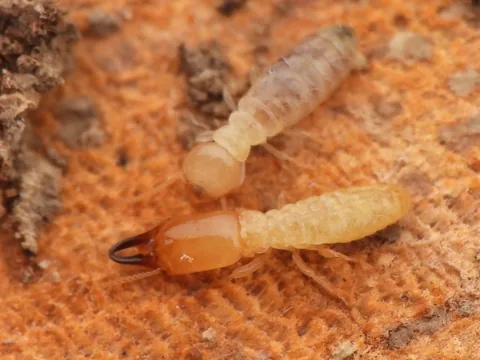 Eastern Subterranean Termite
Reticulitermes spp. (shown: R. flavipes)
Subterranean termites live in the soil and travel into buildings through earthen shelter tubes; they are the most destructive termites in most of the United States and usually warrant a professional.
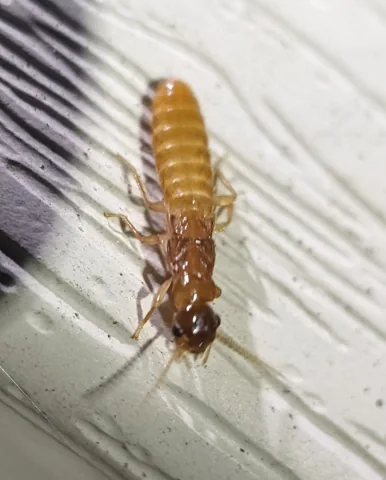 Formosan Subterranean Termite
Coptotermes formosanus
The Formosan subterranean termite is an invasive species from East Asia and one of the most aggressive and economically damaging termites in the world; its colonies are much larger than those of native subterranean termites. EPA lists it among the less common termites in the U.S., behind the native subterranean termite.
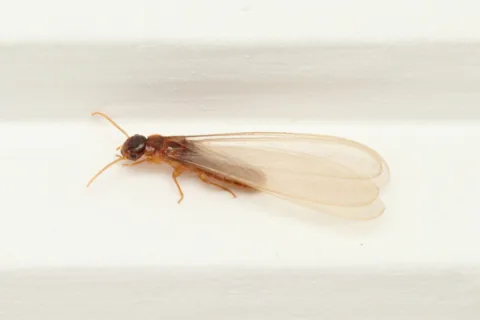 Asian Subterranean Termite
Coptotermes gestroi
The Asian subterranean termite is a very destructive tropical termite, considered second only to its relative the Formosan subterranean termite. In the U.S. both invasive Coptotermes species are established in Florida, and the Asian species has spread beyond South Florida, where it was first confined.
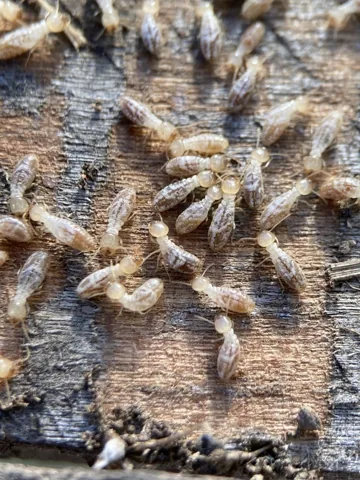 Western Subterranean Termite
Reticulitermes hesperus
The western subterranean termite lives in soil and travels through mud tubes to feed on wood, including the lumber in houses. Its genus, Reticulitermes, holds the most destructive termites found in California and ranks among the most economically important wood-destroying pests in the western United States.
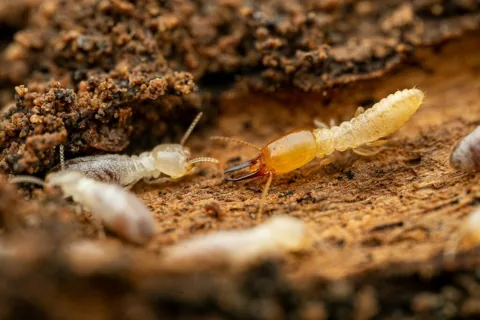 Desert Subterranean Termite
Heterotermes aureus
The desert subterranean termite is the most common and by far the most destructive termite in Arizona, and researchers call it the most economically important termite pest there. It lives in the soil and builds mud tubes to reach wood, from cactus ribs and fence posts to the timbers of houses.
How a liquid treatment works
The most common way to treat a termite infestation is a soil-applied barrier treatment, using a termiticide labeled specifically for that use. Products that only claim to kill termites haven't shown they can protect a structure; they kill only the termites that contact them, not the whole infestation.[2][5]
NC State Extension makes the same point about sprays: spraying swarmers or the surface of infested wood may kill the termites you see, but it doesn't stop the infestation or protect the house from future attack. The most common treatment is a trench-and-treat job that puts termiticide into the soil around the foundation.[5]
Termites can detect repellent insecticides, usually pyrethroids, and avoid them without getting a lethal dose. Non-repellent products such as fipronil, imidacloprid and chlorantraniliprole kill termites that tunnel into the treated soil, and University of Kentucky entomologists say they're usually more reliable at controlling an infestation on the first attempt.[4][3][6]
Iowa State Extension says non-repellent termiticides became available about 2000. Termites don't detect them and keep moving through the treated soil, and slow-acting ingredients can be carried back and shared with other members of the colony. Both kinds can protect a structure when used by the label.[6]
In most cases, termites already inside the building die off too, because they can't get back to the soil for the moisture they need.[3]
Depending on the label, these products can also be used as local treatments aimed at the nest through termite shelter tubes.[4]
A full treatment or an exterior perimeter treatment
A conventional treatment of a slab home combines trenching and rodding along the foundation with drilling through the slab along the inside of the foundation walls, including the garage, and along expansion joints, cracks, and plumbing and utility lines that come up through the slab.[1][9][7]
For existing homes, Texas A&M AgriLife says termiticide should go into the soil inside and outside the foundation walls, around piers and other supports and around utility entrances, and that areas under earth-filled porches, around fireplaces and along adjacent patios and sidewalks must be treated too.[9]
Some products, Termidor SC among them, also allow an exterior perimeter/localized interior treatment. The applicator makes a continuous treated zone along the outside of the foundation, drilling through adjoining patios, porches and sidewalks, and treats inside only where there's termite activity, such as swarmers indoors or mud tubes with live termites.[1]
The label describes that method as designed to be noninvasive to the inside of the home, says it may not be considered a conventional complete treatment, and suggests asking your lead state agency if you have questions about it.[1]
Treating only the spot where you saw termites is usually a gamble, except as a retreatment under a warranty, because a colony forages in many directions and will likely find another way in. Most reputable firms won't warrant spot treatments.[3]
NC State agrees that a spot treatment may not correct the problem and, except under an existing contract, often carries a very limited guarantee or none at all. Iowa State notes that spot treatments, such as along only one side of the house, are done at the company's discretion.[5][6]
States can set their own minimums. North Carolina's regulations require drilling and treating attached concrete slabs such as a garage floor or earth-filled porch, and voids in foundation walls and piers within 4 feet of known termite activity. Any part of a new treatment that won't meet those rules has to be listed on a Waiver of Minimum Standards form that you sign, so make sure you understand what isn't being done and why.[5]
What the crew does
These are the Termidor SC label's directions; other termiticide labels have their own, so read the one used on your home.[1][2]
- Trenching along the foundation walls and around piers and other foundation elements, at least 6 inches deep but never below the bottom of the footing. The trench needn't be wider than 6 inches, and the termiticide is mixed into the soil as it's put back.[1][5][8]
- Rodding: injecting termiticide into the soil through long metal rods, from the bottom of the trench or from grade, with rod holes no more than 12 inches apart. Rodding alone is used where a walkway or other obstruction prevents trenching.[1][3][7][8]
- Volume: the label's standard rate along foundations is 4 gallons of diluted termiticide per 10 linear feet per foot of depth, and a typical treatment may use hundreds of gallons.[1][3][5][6]
- Drilling through the slab along the inside of the foundation, with holes no more than 12 inches apart and termiticide injected into the soil below. Where flooring or finishes rule out drilling from inside, the applicator may drill from outside the foundation at an angle to reach the soil under the slab.[1][9][7]
- Crawl spaces: treating both sides of the foundation and around all piers and pipes.[1][5][9]
- Hollow block walls: drilling into the voids below the sill plate, as close to the footing as practical, so the treated zone runs continuously through the masonry.[1][9]
- Plugging: every drill hole in a commonly occupied area that received termiticide must be plugged with a non-cellulose material or covered with one, such as Portland cement.[1]
- Mud tubes: North Carolina's rules require the applicator to remove termite tubes as part of a complete liquid treatment, and NPIC also advises destroying the mud tubes you can find. Clearing them shows later whether termites are still active or have come back in the same spot.[5][10]
How deep the treatment goes
The vertical treated zone runs from the soil surface down to the top of the footing. The fipronil label used for this guide says to treat from grade to the top of the footing, or to a minimum of 4 feet if the footing is more than 4 feet below grade, and never below the bottom of the footing.[1][5]
NC State's example shows how the volume adds up: at 4 gallons per 10 linear feet per foot of depth, a 40 by 30 foot house (120 linear feet) with a one-foot-deep footer needs 48 gallons just for the soil along the outside wall, and the total can easily pass 100 gallons once inside walls, garage slabs and porches are added. Most footers in eastern and central North Carolina are about 12 to 18 inches below grade, but basements and homes on slopes can need treatment as deep as 4 feet.[5]
Sources describe the depth a little differently. North Carolina's pre-construction standards call for treating to a minimum depth of 4 feet along foundation elements at the same 4 gallons per 10 linear feet per foot of depth, while Iowa State describes a complete barrier injected from the surface to a depth of 3 to 5 feet. The label on the product used at your home is what sets the requirement.[8][6][1]
Wells, drains, ducts and other things that change the job
Termiticide in the wrong place can contaminate heating ducts or damage radiant heat pipes and water or sewer plumbing under the building, and soil-applied insecticides must not leach into groundwater or run off into surface water. That's part of why applicators get special training.[4]
The Termidor SC label doesn't allow treatment until heating and air-conditioning ducts, air vents, plumbing pipes, sewer lines, floor drains, heating pipes and electrical lines are known and identified, and the applicator must not puncture or contaminate them. If you know where any of these run, tell the applicator.[1]
Before drilling through a patio, porch, sidewalk or slab, the applicator must make sure there are no living areas below that the treatment could contaminate.[1]
- Wells and cisterns: no termiticide within 5 feet. Soil 5 to 10 feet away, and soil around a well pipe that enters the house within 3 feet of grade, may only be treated by the backfill method: the soil is dug out onto heavy plastic sheeting or into a wheelbarrow, treated, and returned to the trench after it absorbs the termiticide. NC State notes that a well or cistern under or too close to the foundation can make a liquid treatment illegal.[1][5]
- French drains and sump pumps: the soil must be dry, there's no rodding through the slab within 24 inches of the drain, no treatment within 5 feet of the sump pit and pump, and no drilling through hollow block foundation walls that border the drain. North Carolina's standards add that where drain tile or French drains could carry termiticide outside the treated zone, the treatment must be done so none gets into the drainage system.[1][8]
- Weather: no treatment during rain or when the soil is saturated or frozen.[1]
- Food plants: no treatment within a foot of the drip line of edible plants, and none to fruit or nut trees.[1]
- When wells, drainage systems, ducts under the slab or an inaccessible crawl space make it impossible to treat to industry standards, some companies won't offer a warranty.[3]
When baits may fit better
NC State lists situations where a conventional liquid treatment is especially difficult, undesirable or even impossible: a foundation drain that may lead to a pond or creek, heating or air-conditioning ducts under or in a slab, slab drilling through wood, tile or carpeted floors, a well or cistern under or too close to the foundation, or simply not wanting liquid pesticide around the house. In those cases there are few alternatives: termite baits, or mechanical control, which NC State says is currently available only for homes under construction.[5]
Penn State says baits are especially important for structures with wells or springs close to the foundation, drainage tiles around it, air ducts under or embedded in the slab, or a high water table year-round. North Carolina's agriculture department also notes baits can be used where a well, inaccessible infested areas or concerns about pesticides rule out liquids.[7][8]
Baits work differently. Texas A&M says they're designed to suppress the colony rather than keep termites out, control can take several months to more than a year, and baits give no residual protection once they're discontinued. On the plus side, they need no drilling through slabs, sidewalks and patios, use much less insecticide, and let residents stay home during the application.[9]
Iowa State notes that some situations call for both: a liquid application for quick control plus bait stations for long-term monitoring. For a fuller comparison, see the treatment-options guide linked below.[6]
Before and during the treatment
Firms offering termite services must be licensed by your state. Ask to see the license, ask the company for a copy of the product label if you want to read it, and call your state pesticide regulatory agency if you have concerns.[2][9]
Penn State and Iowa State both suggest getting inspections and written estimates from at least three licensed companies, since firms offer different treatments and warranties. NPIC adds that comparing estimates, inspections, treatment and warranty information from several companies helps you choose between companies, products and methods.[7][6][10]
Only applicators wearing the protective equipment the label requires may be in the immediate area while termiticide is being applied. NC State notes that most labels require applicators working in confined spaces such as crawl spaces to wear specific protective equipment, such as a cartridge-type respirator rather than a simple dust mask.[1][5]
Before treating next to a building, the applicator must check for visible cracks and holes that could let termiticide leak inside. If you're in the house during the treatment and see any sign of leakage, the label says to take yourself and your pets out of the building.[1]
After applying, the applicator must check for leaks and clean up any termiticide that ended up somewhere the label doesn't allow before leaving, and residents, children and pets must stay out of any contaminated area until that cleanup is done.[1]
Ask when you can return. The time before a home can be reoccupied varies by product and is stated on the label, and the applicator should tell you when you're allowed back in.[2]
Most newer liquid products have essentially no odor. If you're still uneasy about a soil treatment, a bait system is the alternative to ask about.[3][9]
Treating before a house is built
Pre-construction treatments can be made at any stage of building, up to and including installation of the final grade, and work by establishing complete horizontal treated zones in the soil under slabs and vertical zones along foundations.[1][8]
Before each application the applicator must notify the general contractor or site superintendent, who tells workers to leave the treatment area and stay out until the termiticide has been absorbed into the soil.[1]
Under the slab, North Carolina's standards have the termiticide applied to the fill after it's in place and before the concrete is poured, at 1 gallon per 10 square feet, or 1½ gallons per 10 square feet where the fill is washed stone. The label used here gives the same 1.0 to 1.5 gallon range for horizontal treatment under slabs.[8][1]
Texas A&M advises asking the contractor or architect to specify that all the soil be treated before the slab is poured, not just around the plumbing penetrations, and that the outside perimeter be trenched and treated after the final grade. It calls this the one time in a building's life when the soil under the slab can be protected.[9]
Expect several visits. North Carolina lists four stages: after footing approval and before the footings are poured, after the crawl space foundation is backfilled, after slab areas are leveled, and after or during backfill and final grading outside. With careful scheduling it can usually be done in three trips. If a slab is poured without treatment, North Carolina uses a release form that tells the owner which areas weren't treated.[8]
After the treatment
How long a treatment lasts depends on the product, how thorough the application was, the region, local conditions and how many termites are on the property.[3][5]
Estimates of how long a treatment lasts vary. EPA requires manufacturers to show their products protect a structure for at least five years, and NC State and Iowa State put properly applied termiticides at about 5 to 10 years, while Texas A&M says lethal termiticides provide approximately 5 years of protection. NC State adds that disturbing the treated soil during renovations or landscaping can give termites a way in.[5][6][9]
Even good treatments sometimes fail when termites find untreated gaps in the soil, because a truly continuous treated zone is hard to achieve in practice. If termites swarm and keep infesting the building the year after treatment, the cause is a gap in the treated zone, not the termiticide breaking down.[3]
Penn State points to treatment failure rates of 20 to 30 percent in some areas and advises keeping a warranty for at least one to two years to see whether the treatment worked.[7]
That's why the service agreement matters. If termites return, most companies retreat the affected areas at no extra charge as long as the annual renewal is kept up, and Kentucky's extension entomologist calls it a bit of a gamble to buy any termite treatment without an ongoing agreement.[3][5]
If you think a treatment was misapplied, file a complaint with your state pesticide regulatory agency. The National Pesticide Information Center (1-800-858-7378) can answer questions about the product and its health effects.[2]
What the warranty covers
Most treatments come with a warranty, and the details differ a lot from company to company. NC State and Penn State both say to read the contract carefully before you sign.[5][7]
- Retreatment only or repairs too: many contracts only promise to retreat. Others also pay for repairs to wood damaged by termites, and those may carry a higher renewal fee.[5]
- Damage that was already there: companies don't want to be liable for damage that happened before they treated, and even a thorough inspection may miss some. Penn State suggests a detailed written record of current and past termite activity before treatment and a damage-replacement clause when you can get one.[7][5]
- What's excluded: a subterranean termite warranty won't cover other wood-destroying pests such as wood-boring beetles, carpenter ants or drywood termites, and companies may limit coverage when renovations disturb the soil along the foundation or additions go untreated.[7][5]
- Annual inspections, not annual spraying: a contract usually means a yearly inspection. NC State says retreating every year without evidence of termites is illegal under most termiticide labels; when activity turns up, the company usually does a local treatment of that area.[5]
- Your part: you may be expected to fix moisture problems and other conditions the inspector reports, and NC State warns that not correcting them can void the contract.[5]
- Booster treatments: some companies require a partial retreatment after a set number of years to keep the guarantee, and it's usually not covered by the existing contract. Look for that term before signing.[5]
Common questions
- Will a liquid termite treatment harm my family or pets?
- Kentucky entomologists say registered termiticides pose no significant hazard to people, pets or the environment when applied according to label directions. EPA notes that many termiticides are highly toxic, which is why the label directions matter, and anyone with lingering concerns should talk to their physician.[3][2]
- Do they have to drill holes inside my house?
- In a conventional treatment of a slab home, yes: holes go through the slab along the inside of the foundation walls, including the garage. An exterior perimeter/localized interior treatment is designed to be noninvasive inside and treats indoors only where termites are active.[1]
- Can I do a liquid treatment myself?
- For a home infestation, it's best not to. The work takes knowledge of building construction, powerful masonry drills, large spray tanks and long injection rods, and do-it-yourself products seldom eradicate an existing termite problem. Penn State, Iowa State, Texas A&M and NC State all advise against treating your own home, and UC IPM says there are no reliable over-the-counter termite control products for the public in California.[3][7][6][9][5][4]
- How long does a liquid termite treatment last?
- All liquid termiticides are supposed to control termites for at least five years when applied by the label. NC State and Iowa State put properly applied treatments at about 5 to 10 years, and how long one lasts on your home depends on the product, how thoroughly it was applied, local conditions and termite pressure.[3][5][6]
- Does a termite contract pay for damage?
- Not always. Many contracts are retreatment-only; others also cover repairs to termite damage, which may cost more to renew. Damage that existed before treatment is generally excluded, so get a detailed record of existing damage first.[5][7]
Photo credits
- Eastern Subterranean Termite: (c) Sam Kieschnick, some rights reserved (CC BY) — via iNaturalist, CC BY 4.0
- Formosan Subterranean Termite: (c) ncb1221, some rights reserved (CC BY) — via iNaturalist, CC BY 4.0
- Asian Subterranean Termite: (c) Carlos Alexandre Mattos Raposo, some rights reserved (CC BY) — via iNaturalist, CC BY 4.0
- Western Subterranean Termite: (c) Z, some rights reserved (CC BY) — via iNaturalist, CC BY 4.0
- Desert Subterranean Termite: (c) Jake Nitta, some rights reserved (CC BY) — via iNaturalist, CC BY 4.0
Sources
- U.S. EPA Pesticide Product Label System, “Termidor SC Termiticide/Insecticide label, EPA Reg. No. 7969-210 (EPA-stamped, April 30, 2024).” www3.epa.gov/pesticides/chem_search/ppls/007969-00210-20240430.pdf (accessed 2026-11-10)
- U.S. Environmental Protection Agency, “Termites: How to Identify and Control Them.” www.epa.gov/safepestcontrol/termites-how-identify-and-control-them (accessed 2026-11-10)
- University of Kentucky Entomology, “ENTFACT-604: Termite Control: Answers for Homeowners (Michael F. Potter).” entomology.ca.uky.edu/ef604 (accessed 2026-11-10)
- University of California Statewide IPM Program, “Pest Notes: Subterranean and Other Termites (Publication 7415).” ipm.ucanr.edu/home-and-landscape/subterranean-and-other-termites/ (accessed 2026-11-10)
- NC State Extension, “Termites - Biology and Control.” content.ces.ncsu.edu/termites-biology-and-control (accessed 2026-11-10)
- Iowa State University Extension and Outreach, “Termite Control in Iowa.” yardandgarden.extension.iastate.edu/encyclopedia/termite-control-iowa (accessed 2026-11-10)
- Penn State Extension, “Eastern Subterranean Termites.” extension.psu.edu/eastern-subterranean-termites (accessed 2026-11-10)
- North Carolina Department of Agriculture & Consumer Services, Structural Pest Control and Pesticides Division, “Pre-Construction Subterranean Termite Control.” www.ncagr.gov/divisions/structural-pest-control-and-pesticides/structural/consumer-information/pre-construction-subterranean-termite-control (accessed 2026-11-10)
- Texas A&M AgriLife Extension, “Subterranean Termites (E-368).” extensionentomology.tamu.edu/wp-content/uploads/sites/3/2017/01/Subterranean-termites-E368.pdf (accessed 2026-11-10)
- National Pesticide Information Center, “Termites.” npic.orst.edu/pest/termite.html (accessed 2026-11-10)