The short answer
- Venomous snakes native to the US: rattlesnakes, copperheads, cottonmouths (also called water moccasins) and coral snakes.[1][9][3]
- Rattlesnakes live across the country; copperheads in the East and as far west as Texas; cottonmouths in the Southeast, in or near water; coral snakes in the South and, as a separate species, in southern Arizona and southwestern New Mexico.[1][4][26]
- Pit vipers have a deep pit between each eye and nostril and vertical, cat-like pupils. Coral snakes have round pupils, and their red rings touch the yellow ones.[9][16][23]
- If someone is bitten, get emergency care right away, keep them calm and still, take off rings and watches, and wash the bite with soap and water. Don't use a tourniquet, ice, a knife or suction, and don't try to catch or kill the snake.[1][2][3]
- Death is rare: CDC says about 5 people a year die from venomous snakebites in the US, and prompt treatment lowers the risk of death and serious injury.[1][2]
If someone may be poisoned
- Snakebite: call 911 or your local emergency number, and get the person to an emergency room. Don't let them drive themselves. Poison Control is at 1-800-222-1222, free and open 24 hours a day.[1][2][3]
- No tourniquet, no ice, no cutting, no sucking out venom, no electric shock, no alcohol, and no aspirin, ibuprofen or naproxen.[1][2][4]
Venomous snakes and look-alikes
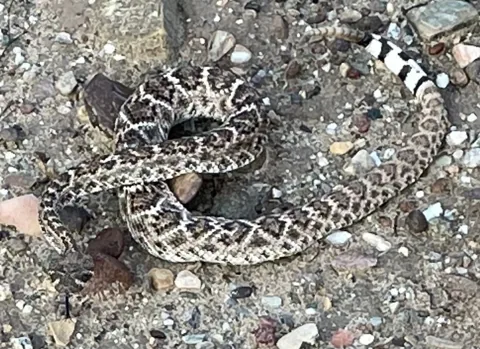 Rattlesnakes (western diamondback shown)
Crotalus species (shown: western diamond-backed rattlesnake, C. atrox)
Rattlesnakes are heavy-bodied pit vipers with a rattle on the tail and the largest venomous snakes in the United States. They eat rodents and rarely bite unless bothered, but a bite is a medical emergency.
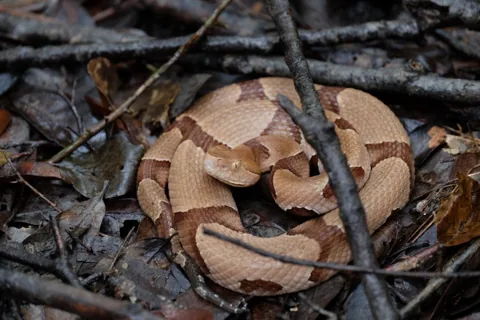 Copperhead
Agkistrodon contortrix
The copperhead is a stout, well-camouflaged pit viper and one of the venomous snakes people most often meet, even in towns. Its venom is relatively mild and deaths are very rare, but any bite needs prompt medical care.
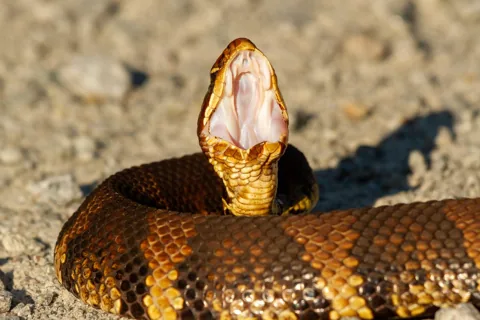 Cottonmouth
Agkistrodon piscivorus (the Florida cottonmouth, A. conanti, is now treated as a separate species)
The cottonmouth, also called the water moccasin, is a venomous pit viper of southeastern wetlands. Its bite is dangerous, but it is not aggressive: it either tries to escape or holds its ground with an open-mouthed warning display, and research indicates it rarely bites unless stepped on or picked up.
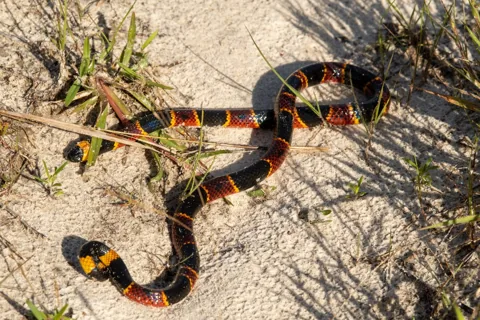 Eastern Coral Snake (Harlequin Coralsnake)
Micrurus fulvius
The eastern coral snake (Micrurus fulvius), also called the harlequin coralsnake, is a slender, brightly ringed venomous snake related to cobras. It is secretive and rarely seen, and bites are rare, nearly always happening when someone picks one up or pins it.
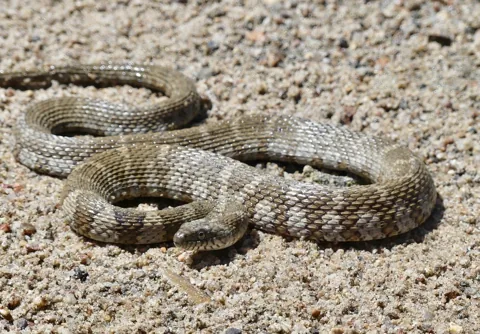 Common Watersnake
Nerodia sipedon
Water snakes are stout, nonvenomous snakes in the genus Nerodia that live in and around fresh water. This page centers on the common or northern watersnake, the most common watersnake in Missouri, and the banded watersnake of the southeastern Coastal Plain.
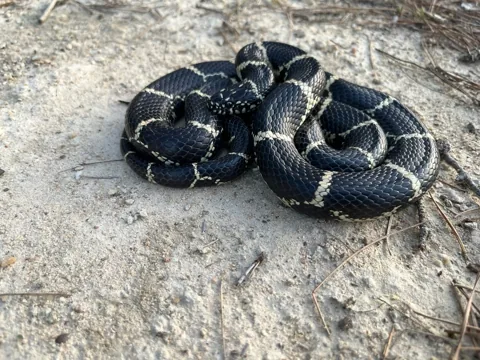 Kingsnakes
Lampropeltis getula
Kingsnakes are glossy, nonvenomous snakes that kill prey by constriction. The eastern kingsnake eats rodents, birds, lizards, turtle eggs and other snakes, including venomous pit vipers, whose venom it resists.
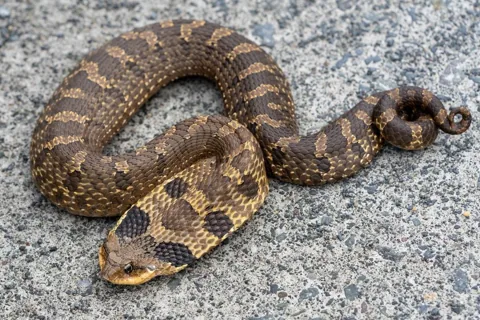 Hognose snakes
Heterodon platirhinos
The eastern hog-nosed snake is a stout, toad-eating snake with an upturned snout. When threatened it puts on a cobra-like show of hissing and neck-spreading, then plays dead. It rarely bites people and is not considered a threat to them.
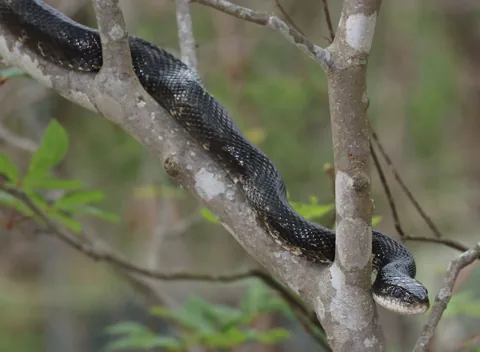 Rat snakes
Pantherophis obsoletus (western ratsnake) and P. alleghaniensis (eastern ratsnake)
Rat snakes are big, nonvenomous constrictors that Missouri's conservation department describes as common and often seen around homes and farm buildings, where they hunt rodents. They are harmless to people and widely considered beneficial, though they also climb after bird eggs and chicks.
The four groups
Rattlesnakes, copperheads and cottonmouths are pit vipers. ICWDM says every venomous snake in North America except the coral snakes belongs to this group. Coral snakes are elapids, with venom the Arizona-Sonora Desert Museum compares to a cobra's; Poison Control says it can affect the nerves.[9][3][27]
Rattlesnakes are the largest venomous snakes in the US, and there are many species. Poison Control says they range from 1 to 8 feet long, with most between 2 and 5 feet, and that the eastern diamondback is the largest venomous snake in the country. A rattle is the obvious mark, but young snakes have only a button or a few segments, rattles break off, and CDC notes that rattlesnakes don't always rattle before biting.[1][4][15]
Copperheads are tan to coppery brown with darker hourglass-shaped bands that are wide on the sides and narrow along the back. CDC gives adult length as about 1.5 to 3 feet; Missouri Department of Conservation gives 24 to 36 inches and Georgia DNR 24 to 30 inches. Young copperheads have a yellow or yellow-green tail tip.[1][17][20]
Cottonmouths are heavy-bodied, dark tan, brown, olive or nearly black, with dark crossbands that can fade as they age. A dark stripe runs through the eye. When threatened they may gape to show the white lining of the mouth that gives them their name. Juveniles are boldly banded and have a yellow tail tip.[1][21][24][5]
Coral snakes are slender, with red, yellow and black rings that go all the way around the body, a small head that isn't distinct from the neck, and a black snout. The eastern species is usually about 20 to 30 inches long in Florida.[23][16][26]
Which ones live where
Ranges below are broad strokes. For a particular species, ICWDM suggests checking a field guide or your state's own snake guide.[9]
- Southeast (Georgia and South Carolina as an example): copperhead, cottonmouth, eastern diamondback rattlesnake, timber (canebrake) rattlesnake, pygmy rattlesnake and eastern coral snake, per the Savannah River Ecology Lab list for the two states. Florida Museum says the cottonmouth, eastern diamondback and harlequin coral snake occur in every Florida county.[22][24][25][23]
- Copperhead range: Georgia DNR describes most of the eastern seaboard, through the central states and over to west Texas. Poison Control says copperheads also turn up in suburban housing areas, woodpiles and rock piles.[20][6][1]
- Cottonmouth range: Georgia DNR gives southeastern Virginia across the coastal plain to central Texas, Oklahoma and Missouri, mostly in swamps and along slow rivers, lakes, farm ponds and creeks.[21][5]
- Midwest (Missouri as an example): the eastern copperhead statewide except the far northern border; the timber rattlesnake, generally statewide; the western pygmy rattlesnake in the far south and eastern Ozarks; and the prairie massasauga, state endangered, in the northwest and a few north-central counties.[17][18][19]
- Texas: 10 rattlesnake species, led by the western diamondback in all but the easternmost part of the state; three copperhead subspecies; the western cottonmouth over the eastern half; and the Texas coral snake, per Texas Parks and Wildlife.[16]
- California: rattlesnakes are the only native venomous snakes, with nine species from below sea level to about 11,000 feet. The western rattlesnake is the most widespread.[15]
- Southwest: the Sonoran (Arizona) coral snake lives across most of southern Arizona and in southwestern New Mexico,. Arizona Game and Fish gives the coral snake's total length as 11 to 24 inches; the Arizona-Sonora Desert Museum gives 13 to 21 inches.[26][27]
- Rattlesnakes in general reach as far north as New England and Washington state, per Poison Control, and are found in mountains, prairies, deserts and beaches, per CDC.[4][1]
Pit viper or harmless snake: what to look at, and the limits
Pits: all pit vipers have a deep pit on each side of the head, midway between the eye and the nostril. Harmless snakes don't.[9][17]
Pupils: pit vipers have vertical, egg-shaped pupils, which can close to a slit in bright light. Harmless snakes have round pupils. Coral snakes are the exception: they are venomous but have round pupils.[9][16][26]
Tail scales: under the tail, pit vipers usually have a single row of scales, and most harmless snakes have two. ICWDM says there are exceptions, so this works on a shed skin but shouldn't be the deciding test.[9]
Head shape: Poison Control warns that the triangular-head rule isn't reliable, because many harmless snakes flatten their heads to look triangular when threatened. UC IPM says California's harmless gopher snake can mimic the triangular head, but it never has a rattle.[3][15]
Sound: bull snakes can hiss like a rattlesnake, and many snakes shake their tails, which can sound like a rattle.[9]
All of these checks put you close to the snake. Poison Control's advice for copperheads makes the point: avoid any snake with the size, color, bands and head of a venomous one, because it is unsafe to get close enough to check for pits and pupils. A photo from a safe distance does the job.[6][1]
Common look-alikes
- Water snakes vs. cottonmouths: watersnakes overlap with cottonmouths in range and habitat. Florida Museum's tells: from directly above you can't see a cottonmouth's eyes but can see a watersnake's; cottonmouths have cat-like pupils and a facial pit; watersnakes usually have thin dark vertical lines on the lips; and cottonmouths often rest with the head tilted up. Snakes that drop from branches into the water are nearly always watersnakes, per Georgia DNR.[24][5][21]
- Corn snakes and northern watersnakes vs. copperheads: Georgia DNR says corn snakes are longer and slimmer with smooth, shiny scales and square, black-edged blotches, while water snakes have a squared pattern that is wider on top than on the sides.[20]
- Gopher snakes and bull snakes vs. rattlesnakes: they can flatten the head and hiss, but have no rattle. UC IPM adds the other side of that: a rattlesnake that has lost its rattle is still a rattlesnake.[15][9]
- Scarlet kingsnakes, scarletsnakes and milk snakes vs. coral snakes: on the harmless ones the yellow rings touch only black, not red, and on scarletsnakes and the milk snakes Texas Parks and Wildlife describes, the rings stop at the belly instead of circling the body.[23][16][9]
- Juvenile cottonmouths vs. copperheads: Florida Museum notes young cottonmouths have many dark spots and speckles in their crossbands, while copperhead bands have none or one.[24]
About 'red touches yellow'
The rhyme (red next to yellow is dangerous, red next to black is safe) matches the native coral snakes in the US, as Texas Parks and Wildlife and Arizona Game and Fish both describe. It isn't a universal rule. Poison Control calls stripe adages not always reliable, and the Arizona-Sonora Desert Museum says the rhyme doesn't always work in its region, where some harmless snakes also have red touching yellow.[16][26][3][27]
The Desert Museum's better checks for the Sonoran coral snake are a very blunt head that is black to behind the eyes, and bands that go all the way around the body. If you aren't sure, leave any red, yellow and black snake alone.[27]
If someone is bitten: what to do
These steps come from CDC's NIOSH page on venomous snakes, MedlinePlus and Poison Control. Treat any snakebite as serious until a professional says otherwise.[1][2][3]
- Get emergency medical care right away. Call 911; MedlinePlus suggests calling the emergency room ahead so antivenom can be ready.[1][2]
- Don't drive yourself. CDC says a snakebite can make you dizzy or pass out.[1]
- Keep the person calm and still. MedlinePlus says to restrict movement, not let them over-exert, and carry them if needed.[1][2][3]
- Take off rings, watches and tight clothing near the bite before swelling starts.[1][2][3]
- Wash the bite gently with soap and water, and cover it with a clean, dry dressing.[1][3]
- With a pen, mark the edge of the swelling or tenderness on the skin and write the time next to it. Doctors use this to see whether it is spreading.[1][6][7]
- If it can be done safely, take a photo of the snake from a distance, or note its color, shape and size. Don't waste time hunting for it. Poison Control says a photo helps but isn't essential.[1][2][3]
- Call Poison Control at 1-800-222-1222 for advice at any point, including whether the snake was likely venomous.[2][3][4]
How to hold the bitten arm or leg
Sources word this differently. CDC says to sit or lie down with the bite in a neutral position of comfort. MedlinePlus and Poison Control's general snakebite pages say to keep the arm or leg at heart level, and MedlinePlus adds a loose splint or sling to limit movement. Poison Control's copperhead page says to immobilize the bite area below the heart. What they agree on: keep the limb still and take off anything tight before it swells.[1][2][3][6]
If the person shows signs of shock, such as paleness, MedlinePlus says to lay them flat, raise the feet about a foot, and cover them with a blanket.[2]
What NOT to do
Most of the old snakebite remedies do harm. Each item below is on CDC's, MedlinePlus's or Poison Control's do-not list, and a 2011 expert consensus on pit viper bites gives the reasons for several of them.[1][2][3][7]
- No tourniquet or constricting band. Poison Control says these don't help and most old treatments make things worse. The 2011 panel also did not recommend pressure immobilization or lymphatic bands for pit viper bites.[1][2][3][7]
- Don't cut the wound or try to suck out the venom, by mouth or with a suction device. The consensus paper says incision and suction don't remove meaningful amounts of venom and can worsen tissue injury.[1][2][7]
- No ice, cold packs, or soaking the bite in water. The consensus paper notes that ice water immersion has been linked to severe tissue injury.[1][2][7]
- No electric shock. Animal studies and human cases found it ineffective and associated with significant tissue injury.[1][6][7]
- No alcohol, and no aspirin, ibuprofen or naproxen. MedlinePlus says not to give stimulants or pain medicines unless a health care provider says to, and not to give anything by mouth.[1][2][7]
- Don't wait for symptoms before getting help. MedlinePlus warns that coral snake bites may not hurt much at first, and major symptoms can take hours.[1][2]
- Don't try to catch or kill the snake, and don't handle a dead one or a cut-off head. MedlinePlus says a dead snake can bite by reflex for several hours.[1][2][4][16]
Symptoms and what happens at the hospital
Around the bite, CDC lists puncture marks; bleeding, redness, swelling, bruising or blistering; and severe pain. Body-wide signs can include nausea, vomiting or diarrhea, trouble seeing or breathing, a fast heart rate with a weak pulse, low blood pressure, a metallic, mint or rubber taste, heavy salivation and sweating, numbness or tingling, and muscle twitching.[1]
Coral snake venom acts on the nerves and can cause weakness and paralysis. Poison Control says there may be no obvious puncture marks, and MedlinePlus says untreated coral snake bites can be deadly even if the bite looks fine.[3][2]
Not every bite injects venom. Poison Control says 20% to 25% of copperhead bites are dry bites and another 15% cause only minor symptoms, with copperhead symptoms developing over 8 to 12 hours. Copperhead venom generally causes milder effects than rattlesnake or cottonmouth venom.[6][3]
Antivenom is given for significant pain, spreading swelling, clotting problems or nerve symptoms. Poison Control says it slows or stops swelling but doesn't reverse it, so swelling and tissue damage can take weeks to settle. Treatment also includes wound care, pain control and a tetanus update.[4][3]
Lasting effects are possible: among people bitten by rattlesnakes, CDC estimates 10% to 44% have lasting problems, such as losing part or all of a finger or reduced use of the bitten area.[1]
How common are bites and deaths?
Estimates of venomous bites per year differ: CDC says about 7,000 to 8,000, MedlinePlus says 8,000 to 10,000, and a 2021 review in the American Journal of Emergency Medicine says 5000 to 10,000. All agree deaths are rare, about 5 a year by the CDC and MedlinePlus figures.[1][2][8]
That 2021 review found 101 deaths from native snakes from 1989 to 2018. Rattlesnakes caused 74 of the 82 deaths where the snake was known (90.2%), copperheads 5, cottonmouths 2 and the eastern coral snake 1. Many fatal bites came from deliberately handling the snake, including trying to kill it, and alcohol or drug use raised the risk.[8]
Children are at higher risk of serious effects because of their smaller size, per MedlinePlus, and Poison Control notes many bites happen to people walking barefoot or in sandals, often in the dark.[2][3]
Avoiding bites around the house and outdoors
- Leave snakes alone. Texas Parks and Wildlife says snakes don't chase people, and Florida Museum says most eastern diamondback and cottonmouth bites happen when the snake is deliberately bothered or accidentally stepped on.[16][5][25][24]
- Wear shoes outdoors, and boots and long pants in brush or tall grass. Use a flashlight at night.[1][3][2]
- Look before reaching under rocks, logs, woodpiles or brush, and be careful stepping over logs. Wear leather gloves when moving brush and debris.[1][2][6]
- Snakes tend to be most active at dawn and dusk and in warm weather. Poison Control says copperhead bites are most likely from April to September.[1][6]
- Baby rattlesnakes are venomous and do bite, and ICWDM says young venomous snakes are just as venomous as adults.[15][10]
- Don't keep native venomous snakes as pets. UC IPM says many rattlesnake bites happen when people tease or play with a pet rattlesnake.[15]
Making the yard less inviting
Snakes come for shelter and food. Clear woodpiles, board and rock piles, brush and tall grass near the house, keep the lawn mowed, store firewood on a rack off the ground, and keep pet food and feed in sealed containers so rodents don't move in.[13][11][14]
Seal openings around the foundation, crawl space and basement larger than 1/4 inch, and screen vents and drains. Where venomous snakes are common, NPIC suggests a snake-proof fence around a children's play area.[13][14]
Mississippi State says snake repellents are questionable at best and none are registered for snake control, and ICWDM says none have research showing they work in real-world use. Our snake guide covers fence specs, removal and what doesn't work in detail.[13][11]
Dogs and other pets
ICWDM notes that pets and livestock can be badly hurt by a venomous snakebite, especially on the nose or face. UC IPM says a veterinarian should see a dog bitten by a rattlesnake right away, and that a dog barking or whining at something unusual is worth checking for a snake.[12][15]
Should you kill it?
No, and in many places you can't. ICWDM says snakes are protected by law in most states unless they are about to cause damage, and some are threatened or endangered. Missouri, for example, protects all native snakes and allows killing a venomous one only when it is close enough to people to be likely to bite.[9][17]
Trying to kill a snake is also how many people get bitten; the 2021 review of US snakebite deaths lists it among the deliberate encounters behind fatal bites. Back away, give the snake room to leave, and call a wildlife professional if a venomous snake needs moving.[8][16][3]
Common questions
- What venomous snakes are in the US?
- Rattlesnakes, copperheads, cottonmouths (water moccasins) and coral snakes. All but the coral snakes are pit vipers.[1][9]
- Should I put ice or a tourniquet on a snakebite?
- No. CDC, MedlinePlus and Poison Control all say not to use ice, a tourniquet, cutting or suction. Keep the person still, remove rings and tight items, and get emergency care.[1][2][3]
- Should I raise the bitten arm or leg?
- Keep it still. CDC says a neutral, comfortable position; MedlinePlus and Poison Control say about heart level, and Poison Control's copperhead page says below the heart.[1][2][3][6]
- Can a dead snake still bite?
- Yes. MedlinePlus says a snake can bite by reflex for several hours after it dies. Don't handle a dead venomous snake or its head.[2][1]
- Do I need to bring the snake to the hospital?
- No. Don't try to catch or kill it. A photo from a safe distance can help, but Poison Control says it isn't essential.[1][3]
- Is a copperhead bite dangerous?
- It needs medical care, but serious effects are rare. Poison Control says 20% to 25% of copperhead bites are dry, and copperhead venom generally causes milder effects than rattlesnake or cottonmouth venom.[6][3]
- Does 'red touches yellow' always work?
- It fits the native US coral snakes, but Poison Control calls these rhymes not always reliable, and some harmless snakes in the Southwest also have red touching yellow. Leave any red, yellow and black snake alone.[3][27][16]
- Do cottonmouths chase people?
- No. Poison Control and Georgia DNR both say cottonmouths aren't aggressive and will try to escape; one may hold its ground and gape if surprised.[5][21]
Photo credits
- Rattlesnakes (western diamondback shown): (c) Mark Pollock, some rights reserved (CC BY) — via iNaturalist, CC BY 4.0
- Copperhead: Brady Reed, public domain (CC0), via iNaturalist
- Cottonmouth: (c) Joshua Liverman, some rights reserved (CC BY) — via iNaturalist, CC BY 4.0
- Eastern Coral Snake (Harlequin Coralsnake): (c) Court Harding, some rights reserved (CC BY) — via iNaturalist, CC BY 4.0
- Common Watersnake: (c) Aiva Noringseth, some rights reserved (CC BY) — via iNaturalist, CC BY 4.0
- Kingsnakes: (c) Matthew Lumsden, some rights reserved (CC BY) — via iNaturalist, CC BY 4.0
- Hognose snakes: (c) evangrimes, some rights reserved (CC BY) — via iNaturalist, CC BY 4.0
- Rat snakes: (c) hr_dragonfly, some rights reserved (CC BY) — via iNaturalist, CC BY 4.0
Sources
- CDC, National Institute for Occupational Safety and Health, “Venomous Snakes at Work (Sept. 23, 2026).” www.cdc.gov/niosh/outdoor-workers/about/venomous-snakes.html (accessed 2026-11-10)
- MedlinePlus, U.S. National Library of Medicine, “Snake bites (Medical Encyclopedia; review date 10/14/2025).” medlineplus.gov/ency/article/000031.htm (accessed 2026-11-10)
- Poison Control (National Capital Poison Center), “Everything you need to know about snakebites.” www.poison.org/articles/snakebites-in-march (accessed 2026-11-10)
- Poison Control (National Capital Poison Center), “Rattlesnake bites: What you need to know.” www.poison.org/articles/rattlesnakes (accessed 2026-11-10)
- Poison Control (National Capital Poison Center), “How venomous are cottonmouth snakes?.” www.poison.org/articles/cottonmouth-snakes (accessed 2026-11-10)
- Poison Control (National Capital Poison Center), “Are copperhead snakes venomous?.” www.poison.org/articles/copperhead-snakes (accessed 2026-11-10)
- BMC Emergency Medicine, via PubMed Central, “Lavonas et al. (2011), Unified treatment algorithm for the management of crotaline snakebite in the United States: results of an evidence-informed consensus workshop, BMC Emerg. Med. 11:2.” pmc.ncbi.nlm.nih.gov/articles/PMC3042971/ (accessed 2026-11-10)
- American Journal of Emergency Medicine, via PubMed, “Greene, Folt, Wyatt and Brandehoff (2021), Epidemiology of fatal snakebites in the United States 1989-2018, Am. J. Emerg. Med. 45:309-316.” pubmed.ncbi.nlm.nih.gov/33046301/ (accessed 2026-11-10)
- Internet Center for Wildlife Damage Management, “Snakes (Identification).” icwdm.org/species/reptiles/snakes/ (accessed 2026-11-10)
- Internet Center for Wildlife Damage Management, “Snake Biology.” icwdm.org/species/reptiles/snakes/snake-biology/ (accessed 2026-11-10)
- Internet Center for Wildlife Damage Management, “Snake Damage Prevention and Control Methods.” icwdm.org/species/reptiles/snakes/snake-damage-prevention-and-control-methods/ (accessed 2026-11-10)
- Internet Center for Wildlife Damage Management, “Snake Damage Identification.” icwdm.org/species/reptiles/snakes/snake-damage-identification/ (accessed 2026-11-10)
- Mississippi State University Extension Service, “Reducing Snake Problems Around Homes (P2277).” extension.msstate.edu/publications/reducing-snake-problems-around-homes (accessed 2026-11-10)
- National Pesticide Information Center, “Snakes.” www.npic.orst.edu/pest/snake.html (accessed 2026-11-10)
- University of California Statewide IPM Program, “Pest Notes: Rattlesnakes.” ipm.ucanr.edu/home-and-landscape/rattlesnakes/ (accessed 2026-11-10)
- Texas Parks and Wildlife Department, “Snakes (Hunter Education: Preparation and Survival).” tpwd.texas.gov/education/hunter-education/online-course/preparation-and-survival/snakes (accessed 2026-11-10)
- Missouri Department of Conservation, “Eastern Copperhead (field guide).” mdc.mo.gov/discover-nature/field-guide/eastern-copperhead (accessed 2026-11-10)
- Missouri Department of Conservation, “Timber Rattlesnake (field guide).” mdc.mo.gov/discover-nature/field-guide/timber-rattlesnake (accessed 2026-11-10)
- Missouri Department of Conservation, “Western Pygmy Rattlesnake (field guide).” mdc.mo.gov/discover-nature/field-guide/western-pygmy-rattlesnake (accessed 2026-11-10)
- Georgia Department of Natural Resources, Wildlife Resources Division, “Venomous Snakes Fact Sheet Series: Copperhead.” gadnrle.org/sites/default/files/wrd/pdf/fact-sheets/Venomous%20Snakes%20-%20Copperhead.pdf (accessed 2026-11-10)
- Georgia Department of Natural Resources, Wildlife Resources Division, “Venomous Snakes Fact Sheet Series: Cottonmouth.” gadnrle.org/sites/default/files/wrd/pdf/fact-sheets/Venomous%20Snakes%20-%20Cottonmouth.pdf (accessed 2026-11-10)
- University of Georgia Savannah River Ecology Laboratory, “Snakes of South Carolina and Georgia.” srelherp.uga.edu/snakes/ (accessed 2026-11-10)
- Florida Museum of Natural History, “Harlequin Coralsnake (Florida Snake ID Guide).” www.floridamuseum.ufl.edu/florida-snake-id/snake/harlequin-coralsnake/ (accessed 2026-11-10)
- Florida Museum of Natural History, “Florida Cottonmouth (Florida Snake ID Guide).” www.floridamuseum.ufl.edu/florida-snake-id/snake/florida-cottonmouth/ (accessed 2026-11-10)
- Florida Museum of Natural History, “Eastern Diamond-backed Rattlesnake (Florida Snake ID Guide).” www.floridamuseum.ufl.edu/florida-snake-id/snake/eastern-diamond-backed-rattlesnake/ (accessed 2026-11-10)
- Arizona Game and Fish Department, Heritage Data Management System, “Animal Abstract: Micruroides euryxanthus (Sonoran Coralsnake).” azgfd-hdms.s3.amazonaws.com/public/abstracts/Micreury.pdf (accessed 2026-11-10)
- Arizona-Sonora Desert Museum, “Sonoran Coral Snake (Micruroides euryxanthus).” desertmuseum.org/books/nhsd_coral_snake.php (accessed 2026-11-10)