The short answer
- Take away cover and food. Keep the lawn mowed, move woodpiles, brush, boards and rock piles away from buildings, stack firewood on a rack at least 12 inches off the ground, and keep pet food, bird seed and other rodent food in sealed containers.[2][7][8][1][4]
- Seal the building. Fit tight door sweeps and screens, close gaps under garage doors, seal cracks and the holes where pipes and wires enter, and screen vents and drains. Most agencies say to close openings 1/4 inch and larger; ICWDM's exclusion advice goes down to 1/8 inch, the same closures that keep out mice.[4][3][2][7][9][1]
- Where venomous snakes are common, fence a play area with galvanized 1/4-inch hardware cloth, 36 inches tall, buried 4 to 6 inches and slanted outward at 30 degrees, with the stakes inside and a tight gate that swings in.[1][7][8][9][4]
- Skip the repellents. Sulfur, mothballs, lime, cayenne and creosote all failed in tests on black rat snakes, no plant repels snakes, and no commercial snake repellent has been proven to work well enough to recommend.[2][3][9][10]
- A snake left alone will likely move on. Most rattlesnake bites happen when people try to pick up, move or kill the snake, so if one is venomous or you can't tell, keep children and pets back and call a professional.[3][4][13]
- If someone is bitten, call 911 or get to an emergency room, and call Poison Control at 1-800-222-1222 for advice. Don't try to catch or kill the snake, and skip tourniquets, ice and cutting.[16][17][15]
Snakes you may meet around the home
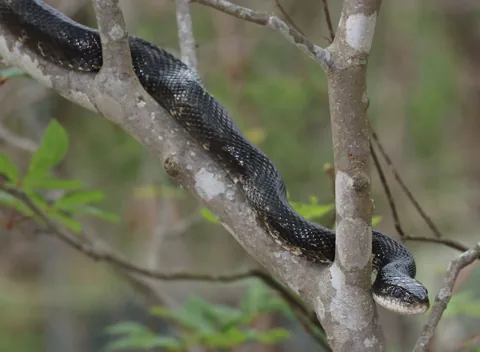 Rat snakes
Pantherophis obsoletus (western ratsnake) and P. alleghaniensis (eastern ratsnake)
Rat snakes are big, nonvenomous constrictors that Missouri's conservation department describes as common and often seen around homes and farm buildings, where they hunt rodents. They are harmless to people and widely considered beneficial, though they also climb after bird eggs and chicks.
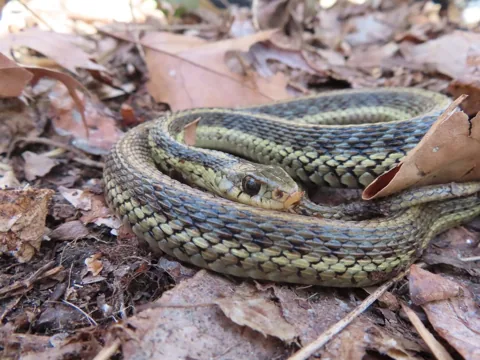 Garter snakes
Thamnophis sirtalis
The common gartersnake is a slender, striped snake that the Missouri Department of Conservation calls harmless, and it is one of the snakes people meet most often in yards and gardens. It may bite and smear a foul-smelling musk if grabbed, but it moves away when left alone.
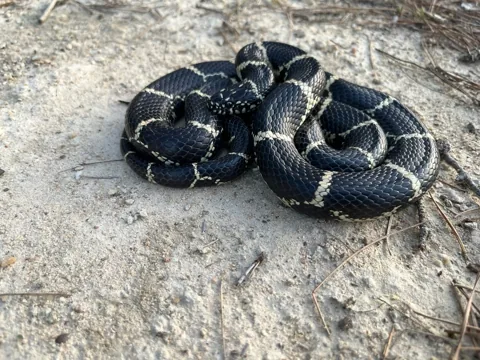 Kingsnakes
Lampropeltis getula
Kingsnakes are glossy, nonvenomous snakes that kill prey by constriction. The eastern kingsnake eats rodents, birds, lizards, turtle eggs and other snakes, including venomous pit vipers, whose venom it resists.
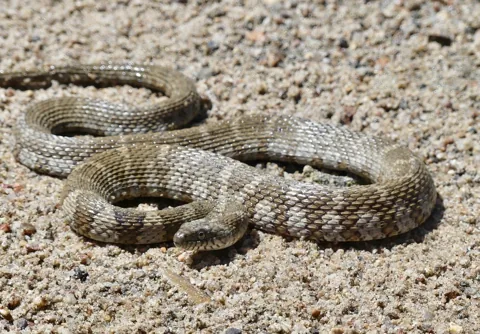 Common Watersnake
Nerodia sipedon
Water snakes are stout, nonvenomous snakes in the genus Nerodia that live in and around fresh water. This page centers on the common or northern watersnake, the most common watersnake in Missouri, and the banded watersnake of the southeastern Coastal Plain.
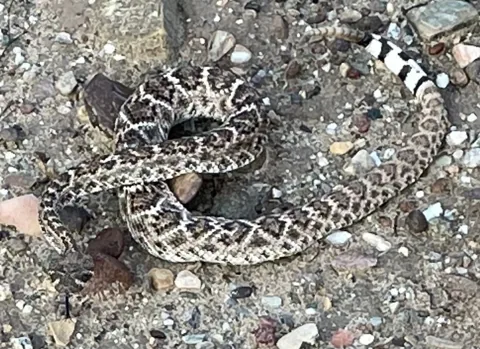 Rattlesnakes (western diamondback shown)
Crotalus species (shown: western diamond-backed rattlesnake, C. atrox)
Rattlesnakes are heavy-bodied pit vipers with a rattle on the tail and the largest venomous snakes in the United States. They eat rodents and rarely bite unless bothered, but a bite is a medical emergency.
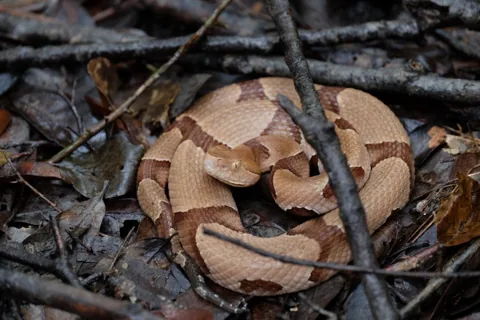 Copperhead
Agkistrodon contortrix
The copperhead is a stout, well-camouflaged pit viper and one of the venomous snakes people most often meet, even in towns. Its venom is relatively mild and deaths are very rare, but any bite needs prompt medical care.
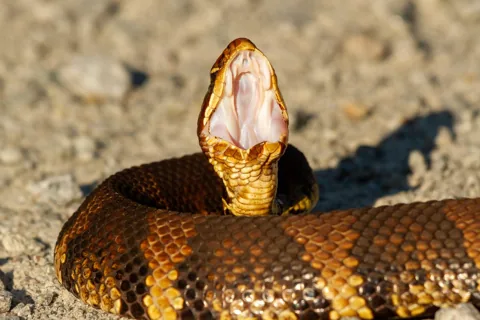 Cottonmouth
Agkistrodon piscivorus (the Florida cottonmouth, A. conanti, is now treated as a separate species)
The cottonmouth, also called the water moccasin, is a venomous pit viper of southeastern wetlands. Its bite is dangerous, but it is not aggressive: it either tries to escape or holds its ground with an open-mouthed warning display, and research indicates it rarely bites unless stepped on or picked up.
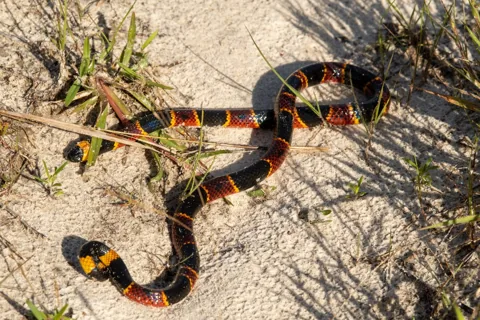 Eastern Coral Snake (Harlequin Coralsnake)
Micrurus fulvius
The eastern coral snake (Micrurus fulvius), also called the harlequin coralsnake, is a slender, brightly ringed venomous snake related to cobras. It is secretive and rarely seen, and bites are rare, nearly always happening when someone picks one up or pins it.
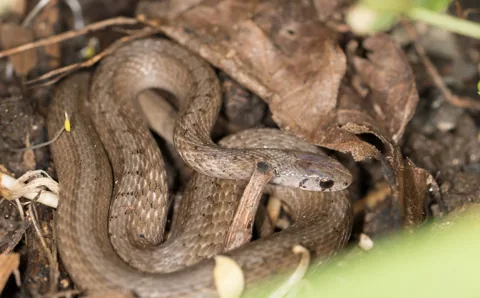 Brown snakes (DeKay's brownsnake)
Storeria dekayi
DeKay's brownsnake is a small, secretive, nonvenomous snake that is often the most common snake in yards, parks and city lots. It feeds mostly on slugs and earthworms, so gardeners have good reason to leave it alone.
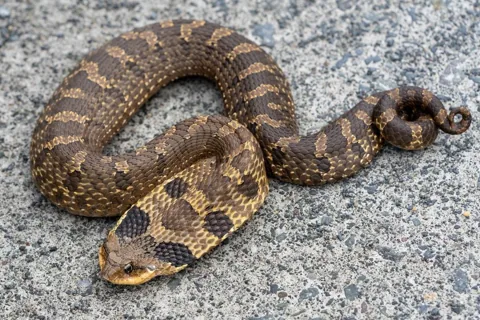 Hognose snakes
Heterodon platirhinos
The eastern hog-nosed snake is a stout, toad-eating snake with an upturned snout. When threatened it puts on a cobra-like show of hissing and neck-spreading, then plays dead. It rarely bites people and is not considered a threat to them.
Why snakes show up
Snakes can't control their body temperature internally, so they look for places that keep them warm in cool spring and fall weather and cool in summer. In early spring they're drawn to warm spots such as metal and rocks; in warm months they look for cool, damp, sheltered places. A snake living around a house is there because it has found food, shelter or other habitat.[2][7]
Most larger snakes eat birds, bird eggs and rodents such as rats, mice and chipmunks, and ICWDM says no plan to control rodent-eating snakes is complete without removing the rodents and their habitat. Penn State Extension says rat snakes, kingsnakes and other rodent eaters live in houses because of a steady food supply, and that removing the food and closing the entrances the rodents and snakes have used usually solves the problem.[1][8]
Snakes also move in to spend the winter. Colorado State says the habit of sheltering under buildings may become more noticeable in fall, when snakes look for places to hibernate, and ICWDM lists sump pumps, rock walls, basements and crawl spaces among the frost-free spots where winter dens form.[9][6][8]
Most snakes seen around houses are harmless species such as garter, ribbon, ringneck, king and rat snakes, which eat rodents, slugs and insect pests; ICWDM says over 90% of the roughly 150 North American species are non-venomous. Kingsnakes, milk snakes, black racers and eastern indigo snakes commonly eat other snakes, including venomous ones.[2][5][7]
Make the yard less inviting
- Keep the lawn closely mowed around buildings and weeds cut, and trim shrubs back from the walls. Missouri and Montana State suggest trimming shrubs so the lowest limbs are at least 12 inches off the ground; Minnesota DNR says at least 6 inches.[1][2][3][4][7][10][11]
- Clear cover near buildings: weedy growth and brushy fence rows, piles of boards, lumber, firewood, rocks, bricks, leaves or grass, logs and rotting stumps. Missouri and ICWDM add flower beds with heavy mulch and shrubs growing against the foundation, and Minnesota DNR suggests smaller pebble or river rock instead of damp mulch or large stones.[2][3][7][6][11]
- Stack firewood away from the house on a rack at least 12 inches off the ground; snakes are less likely to shelter in wood that isn't touching the soil. Mississippi State says wood can sit near the house for a while in cold months, when snakes are inactive.[2][7][8][10]
- Rock walls give snakes shelter and cool temperatures, and Minnesota DNR says retaining walls of loose stone or old railroad ties hide rodents and will attract snakes, so keep such features away from the house where you can.[6][11]
- Cut off the rodents' food. Store pet food, bird seed and animal feed in metal cans with tight lids, pick up pet food after each feeding, put garbage in sealed cans rather than bags, and move bird feeders farther from the house so spilled seed doesn't draw rodents.[1][2][7][11][4]
- Control the mice and rats themselves. Minnesota DNR says getting rid of rodents in the house or garage discourages hungry snakes from coming in; see the rodent and snap-trap guides linked below.[11][4][8]
- Once rodents are under control, fill their old burrows with soil or sod and pack them down firmly. Rattlesnakes can't dig burrows but use the ones rodents dig.[3][11]
- Water draws snake food. Fountains, pools and fishponds can make the ground around them attractive, hot tub or pool pump enclosures that aren't well sealed give cover, and Minnesota DNR says heavy watering of a lawn or garden can bring in the worms, slugs and frogs some snakes eat.[3][11]
- Work carefully around cover. Wear leather gloves when you move brush and debris, look before you reach under rocks or into woodpiles, and tap a pile a few times with a stick or shovel first so a snake has a chance to leave. Snakes are most active at dawn and dusk and in warm weather.[15][14][7]
Seal the house, garage and sheds
Snakes don't gnaw or damage buildings to get in. They use gaps that already exist, so the sealants and closures that keep out mice also keep out snakes. Minnesota DNR says most snakes can fit through a crack 1/2 inch wide, and suggests an energy audit company's leak-finding equipment if you can't find the cracks.[1][11]
Advice on the gap size differs. NPIC, UC IPM, Mississippi State, Missouri, Montana State and Colorado State say to seal openings 1/4 inch and larger. ICWDM's control page gives 1/4 inch in its overview but says in its exclusion advice that every opening 1/8 inch and larger should be sealed.[4][3][2][7][10][9][1]
- Doors: fit door sweeps tightly, and close gaps under garage doors, which are often big enough for snakes, especially young ones. Caulk cracks and openings around windows and doors.[4][3][7]
- Foundations and walls: seal cracks in concrete, block or brick with mortar, use caulk or insulating foam where wires and pipes enter, and patch holes in wooden buildings with sheet metal or fine-mesh hardware cloth (Missouri, Montana State and ICWDM say 1/8-inch mesh). Check walkways and porches for cracks or holes a snake could shelter in.[2][7][10][1][9]
- Check the corners of doors and windows, around water pipes and where utility lines enter, and cover weep vents with weep vent screens.[1]
- Vents, drains and crawl spaces: cover vents and drains that lead into the house with galvanized screening, and inspect crawl space access doors for breaks or gaps. Check entry points into attics and basements too.[4][3]
- Screens: make sure window and door screens fit tightly.[4]
- Under houses, sheds and barns: close off the space with packed soil, bricks, sheet metal or small-mesh hardware cloth reaching about 6 inches below the soil. Snakes can push through loose soil and use rodent holes, but they can't dig through hard soil.[2]
- Pipes: if a septic or treatment plant drainpipe or a sump-pump drain is open at the end outside, cover it with 1/4-inch hardware cloth and check now and then that it doesn't block drainage.[2][7][10]
- Inside: cluttered basements and attics with a rodent, bird or bat problem are among the places snakes are found, so clear clutter and deal with those animals as well.[7][10][6]
Snake-proof fencing
A fence is the one costly method. ICWDM says fencing a whole yard can be expensive but enclosing a play area for children too young to recognize dangerous snakes costs little, UC IPM says fences are often necessary for play areas, and Missouri and Montana State say fencing an entire yard isn't practical but a small area where young children play can be enclosed. NPIC suggests a fence if other methods fail.[1][3][7][10][4]
A properly built fence keeps out all venomous snakes and most nonvenomous ones; some nonvenomous snakes are good climbers.[1]
- Material and height: heavy galvanized hardware cloth with 1/4-inch mesh, 36 inches tall. Burial depth varies by source: ICWDM says 4 to 6 inches, Missouri 4 inches, and Penn State, Colorado State and Montana State 6 inches.[1][8][9][10][7]
- Shape: slant the fence outward from bottom to top at a 30-degree angle and put the support stakes inside; wires from the fence to the stakes make it sturdier. ICWDM says a vertical 36-inch fence with a 12-inch lip at the top, facing out and angled down at 30 degrees, may also work.[1][7][8][10]
- Gates: make them tight-fitting. Because the fence leans outward, gates should swing inward.[1][3][7][8][10]
- Below and beside it: fill any holes under the fence firmly, with concrete if possible, and keep plants and debris cut back along the outside, because snakes can climb vegetation to get over the top.[1][3][7][8][9]
- Lighter options: Missouri describes a temporary fine-mesh net with the bottom 2 to 3 inches set into the ground on stakes slanted out at 30 degrees. Minnesota DNR adds 24-inch hardware cloth with 1/4-inch weave, or aluminum flashing, to the outside bottom of an existing chain-link, picket or split-rail fence, buried 2 to 4 inches; it must go all the way around, because snakes travel along a fence and get in wherever it ends or has an opening.[7][11]
- Upkeep: inspect the fence often for damage, and check it before snakes become active in late winter or early spring.[3]
- ICWDM also describes a border of coarse lava rock at least 12 inches wide, which it says may be as effective as a fence at diverting many snakes, though large snakes may find a way across.[1]
Repellents and other things that don't work
- Home remedies: in tests on black rat snakes, sulfur, lime, mothballs, gourd vines, sisal rope, cayenne pepper spray, artificial skunk scent, a sticky bird repellent, coal tar and creosote, and kingsnake musk all failed. Colorado State's list of the same tests also includes cedar oil and liquid smoke, and UC IPM adds horsehair rope to the remedies that don't work.[2][9][3][10]
- Plants: no plant repels snakes, whatever you may hear.[3]
- Commercial repellents: research on them is lacking or inconsistent, and UC IPM says none has been proven to work well enough to recommend. Sources differ on registration: Mississippi State says no repellents are registered for snake control, while Missouri says the EPA has registered a granular naphthalene and sulfur product, and Penn State says such a product is registered in Pennsylvania but test results haven't been conclusive. Colorado State cites tests in which a naphthalene and sulfur repellent failed against gopher snakes and western rattlesnakes.[1][3][2][7][8][9]
- If you use a chemical repellent anyway, NPIC says to choose only a product whose label says it's a snake repellent and to follow that label, since these products can pose risks to people, pets and the environment when they're misused. Mothballs aren't meant to be used this way, and NPIC says they have little effect on snakes.[4]
- Poisons and fumigants: no toxicants are registered for snakes, and gassing burrows isn't practical because most snakes don't burrow.[1][2][7]
- Frightening devices: ICWDM says they don't apply to snakes.[1]
- Predators: kingsnakes eat rattlesnakes, but too few to matter around a home, so UC IPM doesn't recommend bringing kingsnakes onto your property. ICWDM says raptor perches are unlikely to reduce snake numbers much.[3][1]
- Sticky bands: sticky material applied in 18-inch bands around support poles kept snakes from climbing to wood duck nest boxes. That may help for bird boxes on poles, but Mississippi State says it isn't practical otherwise.[2]
When you find a snake outside
- Keep children and pets back and identify the snake from a safe distance. If you aren't sure what it is, treat it as venomous and don't handle it; a photo can help with identification, and NPIC lists your county extension office and state wildlife agency as places to ask.[4][15]
- Step back and let it go on its way. Clemson notes that a snake leaves by the quickest route, which is sometimes right behind you. A cornered snake may hiss, coil, strike or bluff toward you, which Missouri says leads to the mistaken idea that snakes attack; usually it crawls away if it can reach cover. Missouri's one exception is the male black racer, which may chase people while defending its breeding territory.[14][7][13]
- Don't count on a warning. Rattlesnakes don't always rattle before striking, and many harmless snakes, including black racers, corn snakes, rat snakes, milk snakes and gopher snakes, vibrate their tails in dry leaves and sound like a rattlesnake. Copperheads and cottonmouths vibrate their tails too.[9][15][7][12]
- If it's nonvenomous, the best course is to let it be. UC IPM says a snake left alone is likely to move on, and with the prevention steps done it has no way into the house and no ready supply of rodents.[3][10][7]
- If it's venomous or you can't tell, call a professional rather than handling it. UC IPM suggests a pest or wildlife control operator who specializes in snake removal; NPIC lists your county extension office, animal control officer or state wildlife agency, and in timber rattlesnake country Minnesota DNR points people to its timber rattlesnake responders.[3][4][11]
- Don't try to kill it. UC IPM says trying to kill a rattlesnake can, and sometimes does, get a person bitten, and Texas Parks and Wildlife asks people not to kill snakes at all, venomous ones included. Never handle a dead one either: UC IPM says a rattlesnake can inject venom by reflex for an hour or more after death, and Colorado State says even a decapitated one can bite.[3][13][9][15]
Getting a snake out of the house
- Snakes found indoors are usually in a basement or crawl space. Identify the snake from a distance, keep children and pets away, and try to confine it to a small area.[7][4]
- Broom and bucket: for a nonvenomous snake, sweep it with a broom into a large bucket, garbage can or a box that can be sealed. Sources differ on where to let it go: Mississippi State says as far from houses as possible, Montana State says two miles or more from homes, and Colorado State says to contact Colorado Parks and Wildlife before relocating any snake off your property, so check your state's rules.[2][7][9][10]
- Unless you're skilled at identifying snakes, stay away from its head, and don't grab one by the tail, because it can quickly strike the hand holding it.[2]
- If you can't find it: in a cool basement, look near warm places such as water heaters, gas appliances and refrigerators. Lay piles of rumpled damp cloths or burlap bags, each covered with a dry one to slow drying, where the snake is likely to hide; snakes like the cool, dark, damp shelter. Check them periodically, and when a snake is curled underneath, scoop up the whole pile with a shovel into a box and carry it out.[1][2][7][8][9]
- Glue boards come with drawbacks. Mississippi State and Missouri describe two to four rodent glue boards fixed along one side of a 16-by-24-inch piece of 1/4-inch plywood, set against a wall away from pipes or other objects a snake could use for leverage; cooking oil frees a caught snake. Use them only indoors or under structures, where children, pets and wild animals can't reach them, because they catch anything. Colorado State says to check them at least daily, for humane reasons, and not to leave a snake on one longer than necessary.[2][7][9][1]
- If you can't remove the snake yourself, Missouri suggests finding someone with experience handling snakes, starting with your local animal control shelter; for a venomous snake, call a professional.[7][3]
Snake laws
- Protection varies from place to place. ICWDM says snakes are protected as nongame wildlife in most states. In Mississippi most snakes aren't protected, but no native snake may be sold or traded, four species are listed as endangered by the state, and the eastern indigo and black pine snakes are federally threatened. Missouri treats snakes as nongame with no open season, so killing one is technically illegal there, and all snakes in Pennsylvania are protected by Fish and Boat Commission rules. In California, residents may take most rattlesnake species on private land without a license, with a bag limit of two, but the red diamond rattlesnake may not be taken or killed.[5][2][7][8][3]
- Ask your state wildlife agency before you kill, trap or move a snake. ICWDM notes that captured snakes should be disposed of according to state law and that pit traps may not be legal in your area.[4][1][9]
- If a pet is bitten and has pain, redness, swelling or bruising, take it to a veterinarian right away; UC IPM says a vet should see any dog bitten by a rattlesnake immediately.[4][3]
If someone is bitten
Venomous bites are uncommon but serious. The CDC estimates 7,000 to 8,000 people are bitten by venomous snakes in the United States each year and about 5 die; MedlinePlus puts it at 8,000 to 10,000 bites, also with about 5 deaths. MedlinePlus says to treat any snake bite as serious, since even a nonvenomous bite can sometimes cause significant injury, particularly to children.[15][16]
Call 911 or get to an emergency room right away; don't wait for symptoms. Don't drive yourself, because a bite can make you dizzy or pass out. Poison Control (1-800-222-1222) can help work out whether the bite was venomous and what to do next.[16][15][17]
- Don't try to catch or kill the snake. A photo from a safe distance can help with treatment but isn't essential.[15][16][17]
- Keep the person calm and still, take off rings, watches and tight clothing before swelling starts, and gently wash the bite with soap and water. The CDC also suggests covering it with a clean, dry dressing and marking the edge of the swelling with the time.[15][17][16]
- Limb position differs: MedlinePlus and Poison Control say to keep the bitten arm or leg at heart level, while the CDC says to rest it in a neutral position of comfort.[16][17][15]
- Don't use a tourniquet, ice, electric shock, cutting or sucking out the venom, don't give alcohol, and don't give pain medicines unless a health care provider says to.[15][16][17]
Common questions
- Do mothballs or sulfur keep snakes away?
- No. Both failed in tests on black rat snakes, UC IPM lists sulfur dust and mothballs among home remedies that don't work, and NPIC says mothballs have little effect on snakes. NPIC says to use only products labeled as snake repellents, and only as the label directs.[2][3][4]
- How small a gap can a snake get through?
- Minnesota DNR says most snakes can fit through a 1/2-inch crack. Most agencies say to seal every gap 1/4 inch and larger; ICWDM's exclusion advice goes down to 1/8 inch, the same closures used for mice.[11][4][2][1]
- Will a snake fence keep out every snake?
- A properly built one keeps out all venomous snakes and most others, but some nonvenomous snakes climb well. It has to enclose the whole area, since snakes get in wherever a fence ends; keep vegetation cut back along it and inspect it often.[1][11][3]
- Should I kill a snake I find in my yard?
- No. Trying to kill a rattlesnake can get you bitten, and in many states snakes are protected wildlife. Left alone, a snake will likely move on; for a venomous one, call a professional.[3][13][5]
- Can I catch a snake and move it somewhere else?
- Check with your state wildlife agency first. Montana State suggests releasing a nonvenomous snake two miles or more from homes, Colorado requires a call to Colorado Parks and Wildlife before moving any snake off your property, and Missouri asks for a collecting permit to catch and keep one. Never pick up a venomous snake.[10][9][7][4]
- What should I do if a snake bites me?
- Get emergency care right away and call Poison Control at 1-800-222-1222. Keep calm and still, remove rings and watches, and wash the bite with soap and water. Don't use a tourniquet, ice or cutting, and don't try to catch the snake.[16][15][17]
Photo credits
- Rat snakes: (c) hr_dragonfly, some rights reserved (CC BY) — via iNaturalist, CC BY 4.0
- Garter snakes: (c) Mila C., some rights reserved (CC BY) — via iNaturalist, CC BY 4.0
- Kingsnakes: (c) Matthew Lumsden, some rights reserved (CC BY) — via iNaturalist, CC BY 4.0
- Common Watersnake: (c) Aiva Noringseth, some rights reserved (CC BY) — via iNaturalist, CC BY 4.0
- Rattlesnakes (western diamondback shown): (c) Mark Pollock, some rights reserved (CC BY) — via iNaturalist, CC BY 4.0
- Copperhead: Brady Reed, public domain (CC0), via iNaturalist
- Cottonmouth: (c) Joshua Liverman, some rights reserved (CC BY) — via iNaturalist, CC BY 4.0
- Eastern Coral Snake (Harlequin Coralsnake): (c) Court Harding, some rights reserved (CC BY) — via iNaturalist, CC BY 4.0
- Brown snakes (DeKay's brownsnake): Jesse Rorabaugh, public domain (CC0), via iNaturalist
- Hognose snakes: (c) evangrimes, some rights reserved (CC BY) — via iNaturalist, CC BY 4.0
Sources
- Internet Center for Wildlife Damage Management, “Snake Damage Prevention and Control Methods.” icwdm.org/species/reptiles/snakes/snake-damage-prevention-and-control-methods/ (accessed 2026-11-10)
- Mississippi State University Extension Service, “Reducing Snake Problems Around Homes, Publication 2277 (POD-10-23).” extension.msstate.edu/publications/reducing-snake-problems-around-homes (accessed 2026-11-10)
- University of California Statewide IPM Program, “Pest Notes: Rattlesnakes.” ipm.ucanr.edu/home-and-landscape/rattlesnakes/ (accessed 2026-11-10)
- National Pesticide Information Center, “Snakes.” www.npic.orst.edu/pest/snake.html (accessed 2026-11-10)
- Internet Center for Wildlife Damage Management, “Snakes.” icwdm.org/species/reptiles/snakes/ (accessed 2026-11-10)
- Internet Center for Wildlife Damage Management, “Snake Biology.” icwdm.org/species/reptiles/snakes/snake-biology/ (accessed 2026-11-10)
- University of Missouri Extension, “Snakes: Information for Missouri Homeowners, G9450 (reviewed May 2025).” extension.missouri.edu/publications/g9450 (accessed 2026-11-10)
- Penn State Extension, “Snakes.” extension.psu.edu/snakes (accessed 2026-11-10)
- Colorado State University Extension, “Coping With Snakes, Fact Sheet 6.501.” extension.colostate.edu/topic-areas/natural-resources/coping-with-snakes-6-501/ (accessed 2026-11-10)
- Montana State University Extension, Animal and Range Sciences, “Snakes.” animalrangeextension.montana.edu/wildlife/prevention_and_control/snakes.html (accessed 2026-11-10)
- Minnesota Department of Natural Resources, “Deterring unwanted snakes.” www.dnr.state.mn.us/livingwith_wildlife/snakes/deterring.html (accessed 2026-11-10)
- Washington Department of Fish and Wildlife, “Living with wildlife: Snakes.” wdfw.wa.gov/species-habitats/living/snakes (accessed 2026-11-10)
- Texas Parks and Wildlife Department, “Snakes (Hunter Education: Preparation and Survival).” tpwd.texas.gov/education/hunter-education/online-course/preparation-and-survival/snakes (accessed 2026-11-10)
- Clemson Cooperative Extension Home and Garden Information Center, “Living with Snakes.” hgic.clemson.edu/living-with-snakes/ (accessed 2026-11-10)
- CDC, National Institute for Occupational Safety and Health, “Venomous Snakes at Work (updated Sept. 23, 2026).” www.cdc.gov/niosh/outdoor-workers/about/venomous-snakes.html (accessed 2026-11-10)
- MedlinePlus, U.S. National Library of Medicine, “Snake bites (Medical Encyclopedia).” medlineplus.gov/ency/article/000031.htm (accessed 2026-11-10)
- Poison Control (National Capital Poison Center), “Everything you need to know about snakebites.” www.poison.org/articles/snakebites-in-march (accessed 2026-11-10)